The fall, or really just the approach of fall, can be a rather dreary affair. It’s not so much the retreat of summer or the advance of winter. Nor is it the season itself, as the turning of foliage and the restoration of peace and quiet to our big little valley are, for locals, both highly anticipated events.
I think we all know the real villain looming over our otherwise innocuous autumn: November.
November is a month with one large meal to its credit and not much else. It’s a month whose first move is to steal your afternoons by way of daylight savings; a month that transforms competitive shopping into a holiday and asks you to cast a ballot for people you wouldn’t have over for dinner, all so they can receive healthcare while divining elegant excuses as to why you cannot.
November is akin to February without the skiing and with three extra miserable days tacked on at the end (it’s actually only two, but you forgot because that’s how bad November is).
Mercifully, it is because of the utter abhorrence of November that one needs an indoor hobby. I am all for reading books or constructing cardboard forts for your cats, but for my money, if you want to pass time or simply delete it altogether, you should learn how to make cocktails.
Jumping into cocktail crafting can be overwhelming. Dust-covered bartender bibles are filled with scores of concoctions and it is, if not impossible, ill advised to attempt all of them at once. (Seriously, please do not try all the cocktails at once. You might miss December.)
In order to expedite the journey, the best place to start is at the beginning.
The Manhattan is considered the first modern cocktail. Created in the mid 1870s, it’s a combination of rye whiskey, sweet vermouth and bitters. It is the first cocktail to transcend the tried-and-true triad of spirits, sugar and citrus. The simple innovation of incorporating vermouth led to other classics like the Martinez, the Martini, the Vieux Carre, the Rob Roy, the Boulevardier, and the Brooklyn, among others.
As is often the case in historicism related to alcohol, the fine details of the Manhattan’s inception were probably forgotten by morning (the phenomenon alluded to earlier), making a thorough and definitive history elusive. The most colorful theory is that Winston Churchill’s mother, Jennie Jerome, invented the Manhattan during the New York gubernatorial celebration party for future presidential candidate Samuel J. Tilden.
That name isn’t ringing a bell because he lost.
Unfortunately, Jennie would have been in England at that time recovering from the birth of the rotund future British prime minister famous for his detailed and demanding drinking regimen, rendering this story apocryphal.
Alas, the most likely story, uncovered in David Wondrich’s comprehensive “Imbibe!,” is that the drink was created — or at least made popular — by George Black, who operated a New York saloon from 1874 to 1881 called, suggestively, The Manhattan Inn.
It lacks the illustriousness of a Churchill affiliation, but for historical purposes I suppose it does the trick.
The cocktail quickly gained enough popularity to be favorably reviewed in several newspaper columns in and around New York City. But it wasn’t until 1884 that a recipe was documented in O.H. Byron’s “The Modern Bartender’s Guide,” calling for:
1 pony French vermouth
½ pony whisky
3 or 4 dashes Angostura bitters
3 dashes gum arabic simple syrup
This recipe sits somewhere between a Vermouth Cocktail, which had risen to prominence in the late 1860s, and a modern Manhattan; it’s sweet, with the whiskey taking a backseat to the French vermouth, but it is still delicious and refreshing as an aperitif, making it a perfect post-turkey snack.
From this foundational start, bartenders played around with the ratio, including, notably, the humble celebrity mixologist William “The Only William” Schmidt, who in his 1892 book, “The Flowing Bowl,” settled on the current (mostly) agreed-upon standard of:
2 oz rye whiskey
1 oz sweet vermouth
1 dash absinthe
¼ tsp maraschino
The single dash of absinthe has since lost out to two dashes Angostura bitters and the teaspoon of maraschino is now achieved with a cherry itself, but it’s hard not to admire, and in some way understand, the vanity of our singular hero, “The Only William.”
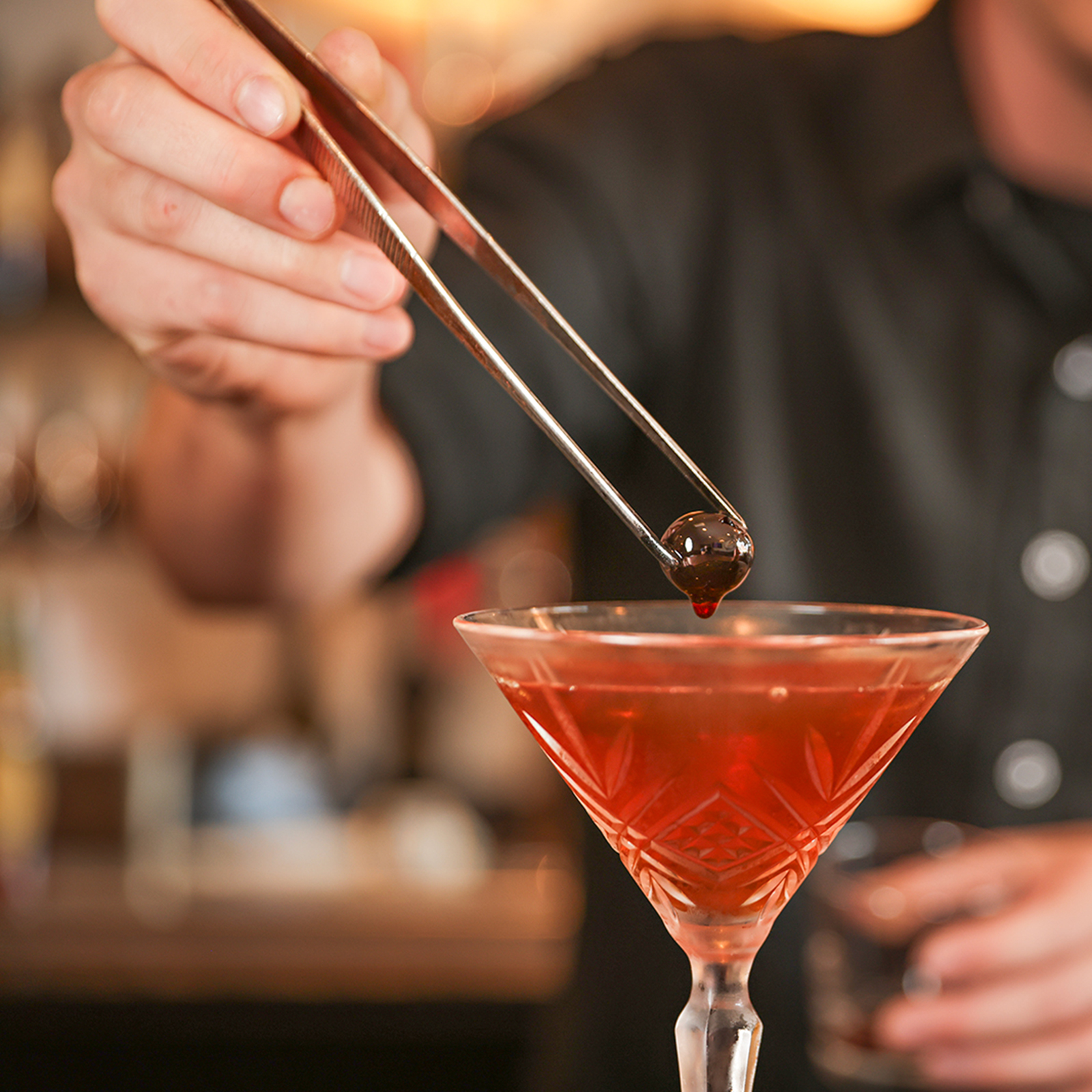
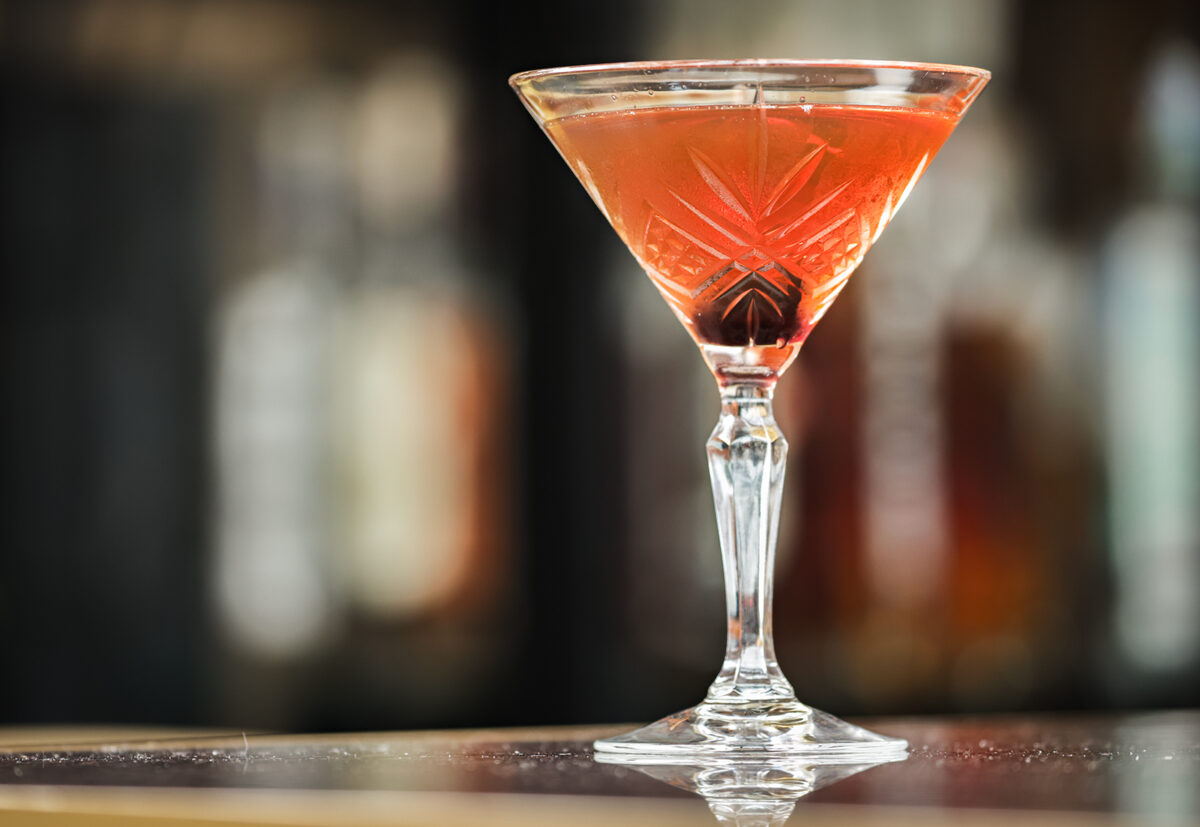
Served in a coupe or a martini glass, the Manhattan looks like a burnt scarlet mountain tarn with a dark cherry at its heart. When raising the glass, the clove and gentian of the bitters reach the olfactory before the rich sweet aroma of the vermouth floods the senses. At first sip, the spice of the rye tumbles forward, almost audibly crackling in the brain before settling down softly again into the sweetness of the vermouth like one would into a giant pillow. The drink is perfectly centered between herbaceous spiciness and lush sweetness.
Metaphorically, the tasting notes fall somewhere between October and December.
A person could play around with the Manhattan forever; or, at the very least, during a cold November, wandering the aisles of their local liquor stores for different ryes, vermouths, and bitters to explore the drink’s nuances.
But November is going to come next year as well as the year after that, so you may need to keep exploring and try your luck with the Manhattan’s offspring.
Almost as soon as the Manhattan was created, so were its spinoffs. The substitution of gin created the Martinez. The further substitution of dry vermouth created the Martini. The possibilities may not be limitless, but they go on and on and on.
Just like November.
Recipes
Perfect Manhattan
2 oz rye whiskey
½ oz sweet vermouth
½ oz dry vermouth
2 dashes Angostura bitters
Garnish: brandied cherry or a lemon twist
Martinez
1 ½ oz gin
1 ½ oz sweet vermouth
¼ ounce maraschino liqueur
2 dashes Angostura bitters
Garnish: orange twist
Rob Roy
2 oz scotch
¾ oz sweet vermouth
3 dashes Angostura bitters
Garnish: brandied cherries
Vieux Carre
¾ oz rye whiskey
¾ oz cognac
¾ oz sweet vermouth
½ oz Benedictine liqueur
2 Dashes Angostura Bitters
2 Dashes Peychaud’s Bitters
Garnish: maraschino cherry or lemon twist