‘Wiggle in the Jetstream’ Helps Boost Flathead River Basin
A wet summer has prevented streamflow volumes from drastically depleting as forecasters originally anticipated as river basins inch toward recovery
By Maggie Dresser
After a hot and dry spring prompted a rapid runoff and left dwindling streamflows, abundant summer rainfall and cool temperatures have helped river basins in northwest Montana recover, despite much of the state remaining in drought conditions.
While water supply is still below average, levels are not lagging too far behind after forecasters earlier this summer predicted extremely low values. Officials in June announced Flathead Lake levels could drop to nearly 3 feet below its full pool of 2,893 feet by the end of the summer. But as of early August, Séliš Ksanka Ql’ispé (SKQ) Dam operators were able to maintain levels a foot below full pool.
“The July rains have helped tremendously, and we’re now forecast to be in the top foot for the end of August,” said Brian Lipscomb, the CEO of Energy Keepers, Inc., which oversees hydroelectric operations on the Flathead Lake.
The precipitation and low temperatures also prevented anticipated hoot owl restrictions, which are triggered when water temperatures reach or exceed 66 degrees Fahrenheit for three consecutive days for westslope cutthroat trout in Montana. According to U.S. Geological Survey (USGS) data, temperatures on the Middle Fork Flathead River peaked at 62.8 degrees on July 30. As of Aug. 8, temperatures were 54.5 degrees.
Streamflows are only slightly below normal in the Flathead River basin despite early runoff. As of Aug. 8, the North Fork Flathead River stream gages read 1,540 cubic feet per second (cfs), down from its median flow of 1,690 cfs. On the Middle Fork, streamflows were at 984 cfs compared to the median of 1,410 cfs.
“May and June were a completely different animal compared to July and August,” National Weather Service hydrologist LeeAnn Allegretto said. “The Flathead was doing great with snowpack numbers and then it all fell off at once, which is the worst-case scenario … then we got snow in Glacier toward the end of June and that set the stage for July.”
Glacier National Park officials on June 20 announced the temporary closure of the alpine sections of Going-to-the-Sun Road when high elevations received several inches of snow. Soon after, July saw well-above average rainfall with 1.14 inches of precipitation – about 130% of normal.
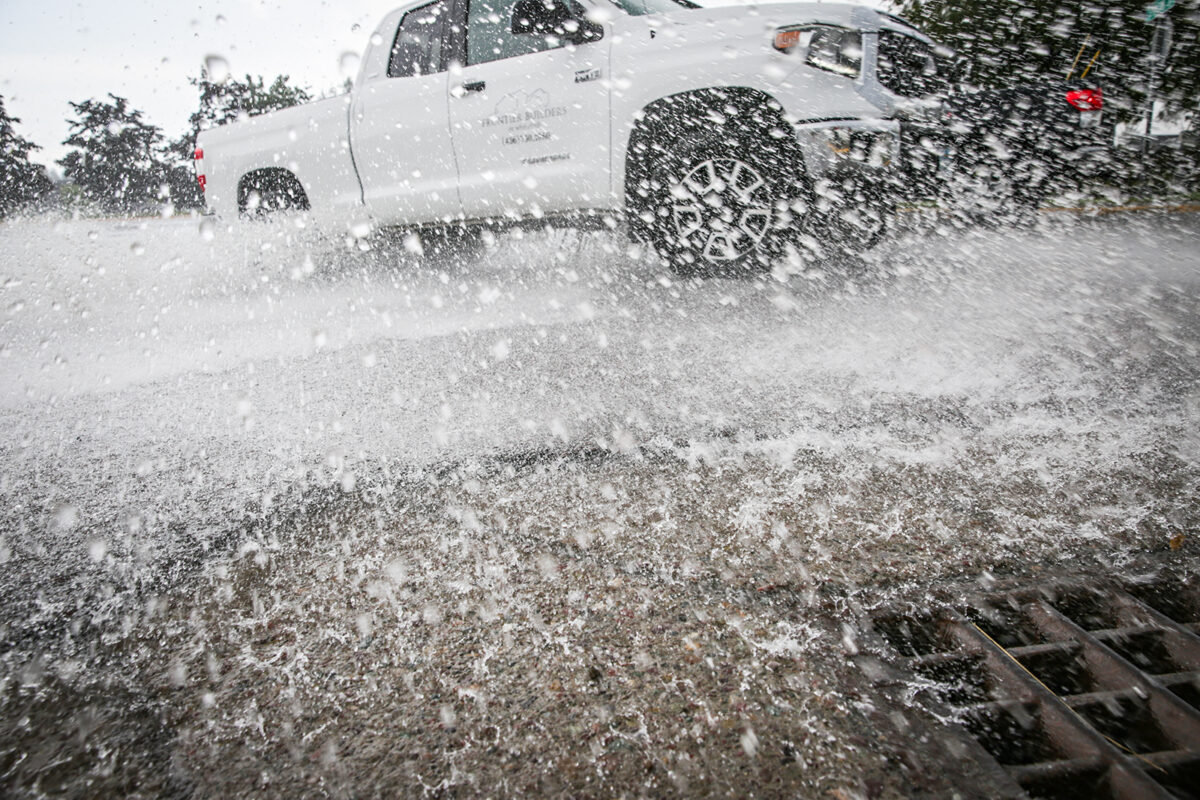
The first week of August is following July’s trends, Allegretto said, with northwest Montana seeing above 130% of normal precipitation and roughly 1 to 3 degrees Fahrenheit below average.
Allegretto says a weak monsoon season in the Four Corners region of the United States – where Arizona, Utah, Colorado, and New Mexico meet – is combining with a series of typhoons in Japan to cause the cool, wet Montana summer.
“What’s really churning all of this is the far Pacific,” Allegretto said. “In Japan, there are a lot of typhoons, and our jetstream is in a position where it normally isn’t and it’s bringing in Pacific moisture. Normally, it would be monsoons in the Four Corners but that never really developed. This is the catalyst of more troughs and widespread precipitation – not the dry thunderstorms we get from monsoons. A little wiggle in the jetstream really did it for us.”
Moisture in the Southwest is instead falling over Texas and California, Allegretto said, which has “opened doors of different moisture feeds.”
While the jetstream shift has boosted moisture in northwest Montana, Allegretto said the Flathead River basin has not made a full recovery, and northwest Montana drought levels range in severity from D1 to D3.
“It’s hard because you can pour two or three drops of water on a dry sponge – it adds to the sponge, but it doesn’t make it moist,” Allegretto said. “We’re adding a few drops, but it’s not inflating. We’re still seeing widespread drought.”
Through mid-August, the National Weather Service is predicting near to above normal precipitation with normal to above normal temperatures in northwest Montana.