Montana Land Board Approves Project to Conserve 53,000 Acres of Timber Forests Near Libby
With support from the wood products industry and hunting and fishing groups, the Montana Land Board's 4-1 vote ensures working forests between Kalispell and Libby remain in timber production while allowing permanent public access
By Tristan Scott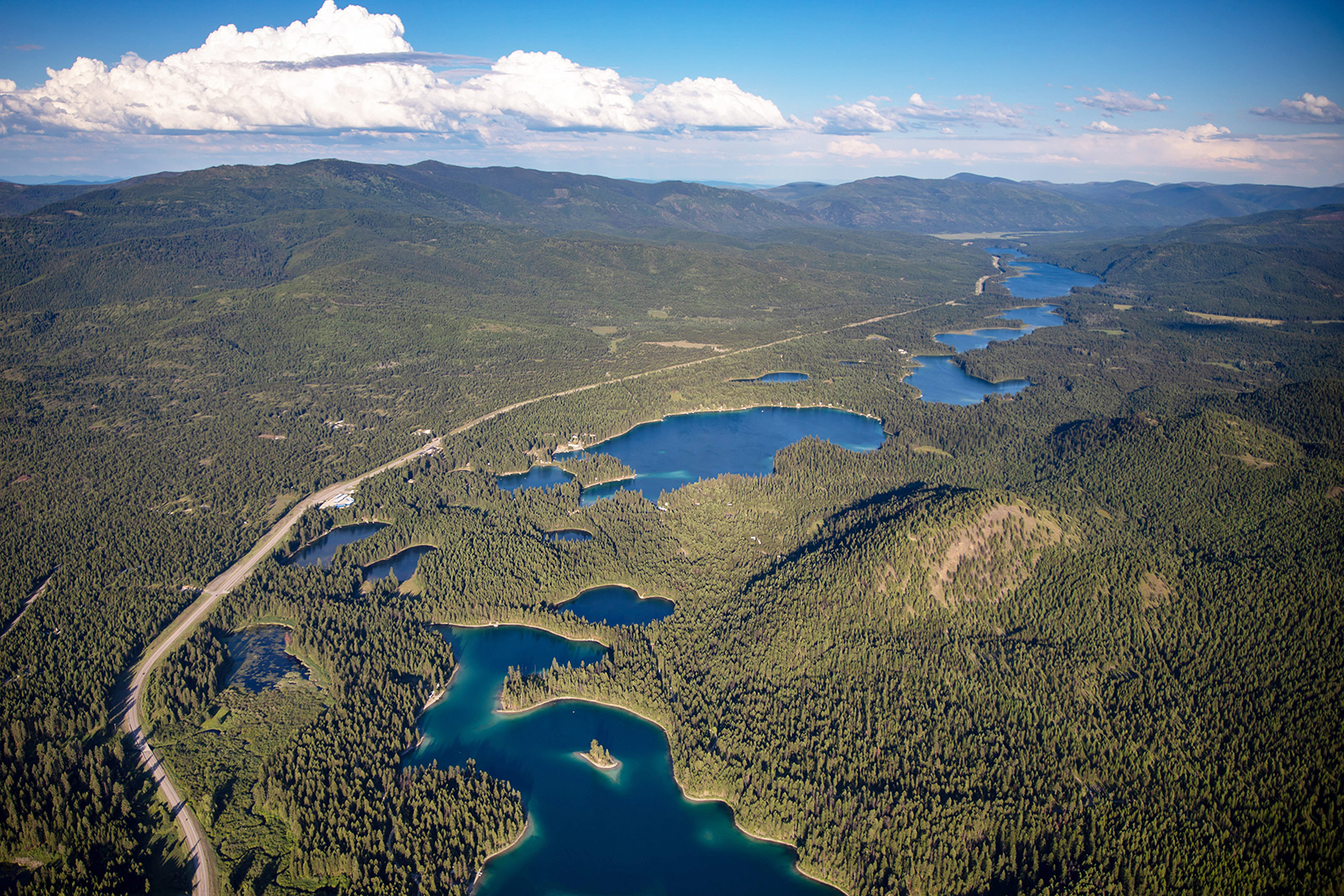
A project to permanently protect 53,000 acres of private timberland in Flathead and Lincoln counties cleared a final hurdle on Oct. 20 when the Montana Land Board delivered a 4-1 vote in favor of a conservation easement that has earned plaudits from a wide-ranging alliance of stakeholders, including the wood products industry, the conservation community, and prominent hunting and fishing groups.
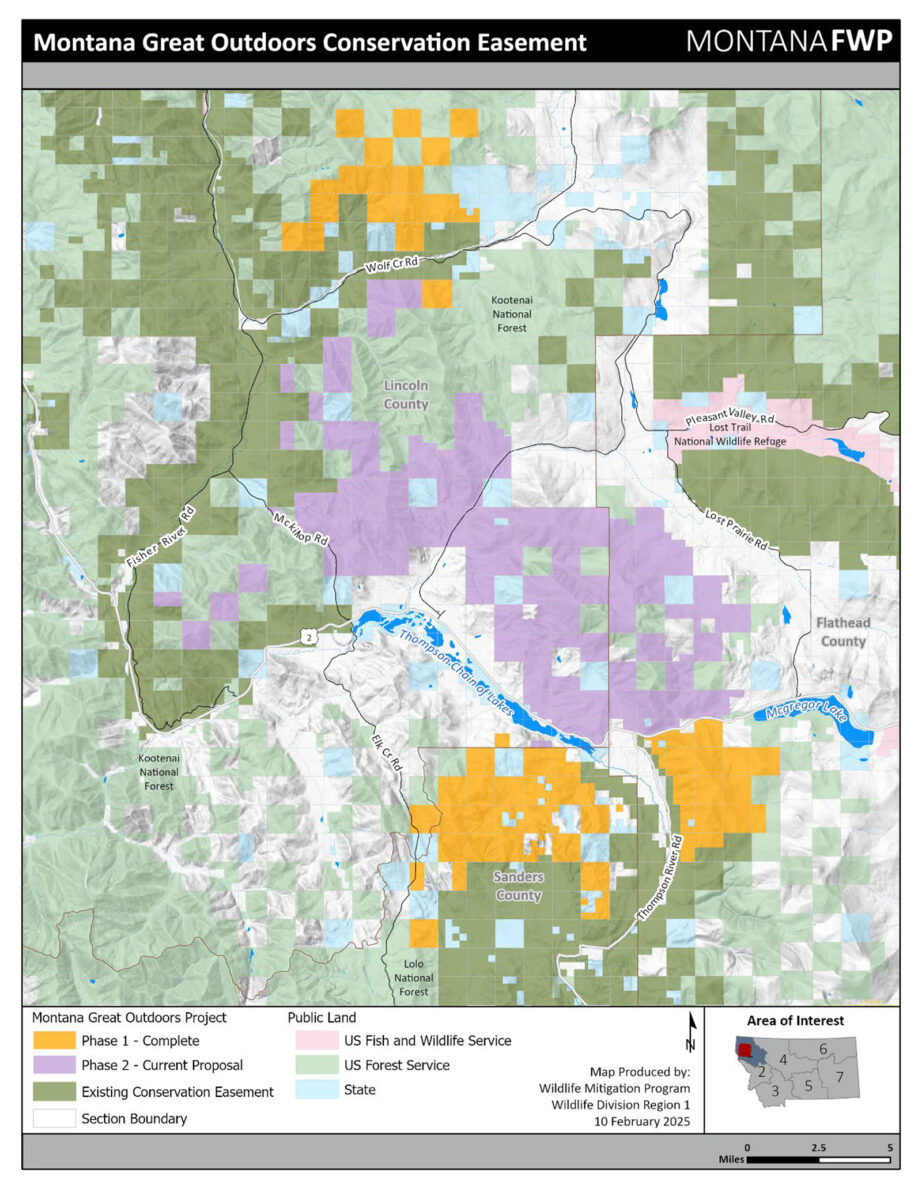
Called the Montana Great Outdoors Conservation Easement, the project is now in its second phase. In total, the project encompasses 85,752 acres of private timberland owned by Green Diamond Resource Company. The first phase of the project, which protected 32,981 acres in the Salish and Cabinet mountains, received final approval from the Montana Land Board in December. The new easement would encompass forestlands in the Cabinet Mountains between Kalispell and Libby.
During Monday’s meeting in Helena, proponents of the project’s second phase included county commissioners, outfitters, hunters and hikers, lawmakers and loggers, regional economic leaders, wildlife advocates, and longtime neighbors who stepped forward to plead their case to land board members using a similar logline: the conservation easement removes development rights while keeping the forest in timber production, guaranteeing public access and preserving wildlife habitat.
“I can’t overstate the consequences of not moving forward with this easement,” said Kyle Schmauch, chief of staff and communications director for the Senate Republicans of the Montana Legislature. As a sixth-generation Montanan who grew up hunting and fishing in the footprint of the conservation easement — harvesting his first deer within shooting range of an adjacent conservation easement’s boundary — Schmauch said he was compelled to advocate for its approval out of personal, not professional, interests.
“It’s going to be parceled out, subdivided into 20- to 60-acre little parcels full of McMansions and ranchettes,” Schmauch said. “This particular chunk of ground, this is where the locals go to recreate. This is where the blue-collar folks go, people who’ve grown up here. This is where they go to escape the crowds and the occupied territories … that have been invaded by Californians and tourists.”
The project is the culmination of a multi-year effort by the Montana Department of Fish, Wildlife and Parks (FWP), the nonprofit Trust for Public Land (TPL) and landowner Green Diamond Resource Company, which in 2021 purchased 291,000 acres of private timberland from Southern Pine Plantations (SPP), the real estate and investment company that in 2019 bought 630,000 acres from Weyerhaeuser Co., which acquired the land in 2016 from Plum Creek.
Despite the succession of private ownership, public access to the property is currently allowed through short-term block management agreements and voluntary open land policies, under which the land has been managed for de facto public access for more than a quarter century.
“A lot of locals up in that neck of the woods where I’m from, a lot of them have never even really understood that these are private lands because they have been so open to pubic hunting, fishing, camping, motorized use, and all types of recreation for so long,” Schmauch said. “This project keeps it that way.”
Barry Dexter, director of resources at Stimson Lumber Company, which owns hundreds of thousands of forested acres spanning northwest Montana, northern Idaho and northeastern Washington, said the pressure on landowners to sell has already converted much of the region’s timber base to non-forest uses.
“Together with Green Diamond, our lands represent the last remaining large tracts of actively managed industrial forest land in Montana,” Dexter said. “I personally have been associated with these private forest lands for 50 years. Over the past two decades, much of the industrial forest land in western Montana has been subdivided and sold off. What remains today is critically important for the long-term future of the forest products industry in Montana and the economies of our rural communities.”
Jim Simpson, a retired forester from Polson, hoped to galvanize the land board’s support by “telling the story” of Montana’s forest products industry’s decline “to the point of near extinction.”
“In 1990, there were about 45 major log processing mills in Montana. Today, we have six operating mills remaining,” Simpson said, noting that conservation easements were among the most effective modern-day tools that could “lead to the stabilization and revitalization of the forest products industry here in Montana.”
“The single most important factor contributing to the loss of our forest products industry is the unpredictable and unaffordable supply of timber,” Simpson said. “Green Diamond’s forests are an important source of that timber supply.”
“If Green Diamond is not able to acquire a conservation easement somewhere along the line, they will look to begin developing these lands for residential purposes,” he cautioned. “When a working productive forest is converted into residential housing, a predictable source of timber disappears.”
For its part, Green Diamond said it’s in the Seattle-based company’s best interests to remove the development interests on its land and allow the trees to regenerate, which is why it’s donating 35% of the land’s value to the state’s purchase of the conservation easement.
“Ten to 15 years ago, this was one million acres of working forest land. Today, we’re down to 300, 000 acres. That is what’s left, and if you want to preserve this stuff and keep it available for your milling industry, for family jobs, for rural economies, this is how we do it,” according to Eric Schallon, Green Diamond’s director of real asset sales. “This is how we stop the fragmentation and pressure from … people coming in and breaking up these working lands.”
Despite setbacks to the timber industry, it remains a critical sector of the economy in Flathead and Lincoln counties, which produced 37% of Montana’s timber volume in 2022, with Flathead County producing 69 million board feet and Lincoln County producing 48 million board feet, according to the Bureau of Business and Economic Research (BBER) at the University of Montana. In 2018, sales from Montana’s forest products industry totaled $553 million and forest industry employment was 7,981 workers.
Under the terms, Green Diamond will maintain ownership of the land while FWP will own the easement. The easement would allow Green Diamond to sustainably harvest wood products from these timberlands, preclude development, protect important wildlife habitat and associated key landscape connectivity, and provide permanent free public access to the easement lands.
Christy Clark, director of FWP, added her voice in support of the project, which she described as among the most important steps Montana can take toward “keeping our forests, our open spaces and our working lands healthy and accessible.”
“This project is located just one hour from Kalispell, our fastest growing city in the state of Montana,” Clark said. “Less public access means more crowding, and no one in our great state is a big fan of that.”
But Clark said the project also provides a key connectivity corridor for grizzly bears traveling between the Northern Continental Divide Ecosystem (NCDE) and the Cabinet-Yaak Ecosystem (CYE), which are designated grizzly bear recover zones under the Endangered Species Act. By furnishing permanent protections on key wildlife habitat and migration corridors, Clark said the project “strengthens our case for state management of grizzly bears.”
“As I stand here today, one priority I’m sure we can all agree on is the grizzly bear is recovered and that it’s time to delist,” she said. “This project makes a critical contribution to that very goal by giving grizzlies room to roam. That connectivity reduces conflict and strengthens the health of the population, helping us meet scientific benchmarks necessary for removing grizzly bears from the ESA.”
Completion of the project would build on the success of the nearby 142,000-acre Thompson-Fisher Conservation Easement (FWP), the 100,000-acre U.S. Fish and Wildlife Service’s Lost Trail Conservation Area and other protected lands including the Kootenai and Lolo national forests, and the Thompson Chain of Lakes State Park.
Even with the groundswell of support for the Montana Great Outdoors Conservation Easement project, it wasn’t an easy sell to some members of the Montana Land Board.
Of the roughly 150 comments submitted to the land board regarding the Montana Great Outdoors Conservation Easement project, including letters of support from trade associations such as the Montana Wood Products Association, and from hunting and angling advocacy groups such as the Rocky Mountain Elk Foundation and the Montana Outfitters and Guides Association, one significant stakeholder opposed it — WRH Nevada Properties, LLC, of Rexburg, Idaho, which owns 42% of the property’s mineral rights underlying a large segment of the project area.
According to FWP’s environmental assessment of the project, a contractor assessed the property and determined that the potential for development of the mineral estate is “so remote as to be negligible.” That didn’t stop WRH Nevada from suing to protect its interests and stop the conservation easement from proceeding, however, which became a sticking point for several land board members who sought reassurance on Monday.
The state land board consists of Montana’s five top elected officials: Gov. Greg Gianforte, Secretary of State Christi Jacobsen, Attorney General Austin Knudsen, Superintendent of Public Instruction Susie Hedalen, and Securities and Insurance Commissioner James Brown. Although the governor has expressed his support for the project, and was instrumental in galvanizing land board support for its first phase one year ago, he was absent during Monday’s proceedings, leaving Lt. Gov. Kristen Juras to preside over the meeting.
“I do want to emphasize that I am also a property attorney with extensive experience,” Juras said, “and it is very clear under this conservation easement that the third-party mineral right owners do have the right to enter the surface to explore and to exercise all of their mineral rights. That is an important consideration as I weigh in on these balancing uses.”
Peter Scott, who represents Citizens for Balanced Use and WRH Nevada Properties, on Monday said he still wasn’t satisfied with the easement’s language, which makes clear the mineral rights would not be diminished. He also said the project “is not going to restore” the state’s beleaguered timber industry. Finally, he explained the easement’s condition of perpetuity — a legal requirement for conservation easements receiving federal funding through the Forest Legacy Program — runs counter to the state GOP’s official platform.
“The GOP in the state of Montana has a direct platform opposing perpetual easements funded by federal dollars and that’s what is before you today,” he said. “So you have a policy choice to make: Do you adhere to the position of our current administration in prioritizing the exploration and development of critical minerals for domestic use or do you prioritize that of the last administration?”
Another layer of opposition arrived Monday from the Montana Mining Association’s executive director, Matt Vincent, who said the decision to oppose the easement at the last minute “is indeed an uncomfortable and unfortunate position because our industry is not opposed to conservation. We are pro-conservation, we are pro-timber development, we are pro-recreation in every way, shape and form.”
“We’re also very pro-private property rights, which is why we find it necessary to stand in opposition to this conservation easement today,” Vincent said.
Attorney General Knudsen was the lone vote in opposition to the project, reciting his long-held tenet that “forever is a long time.”
“We don’t know what the future holds,” Knudsen said. “I’m from the Bakken [Formation]. Forty years ago in eastern Montana, we were all told the same thing: that our minerals were worthless. There’s a whole lot of landowners today that wish they had ignored that advice.”
Commissioner Brown distilled the Land Board’s consideration of the project down to its most basic constitutional duty to approve a perpetual easement if the land acquisition exceeds 100 acres or $100,000 in value. Brown said the state Fish and Wildlife Commission had already vetted the conservation easement’s legality, determining that the state’s investment of $1.5 million from the Habitat Montana program is “a prudent economic investment of state dollars,” particularly as it leverages $35,805,000 of federal funding from the U.S. Forest Service’s Forest Leacy Program.
“I cannot find a fault with the decision of our fish and wildlife commissioners that this is a prudent and highly leveraged investment and a sound public-private partnership,” Brown said.
Secretary Jacobsen also supported the project’s second phase after reluctantly supporting its initial phase last year.
“I did not take this decision lightly. I have lost sleep over it and I’ve been thinking about it for six months,” she said. “I appreciate and I’m a champion of the Montana Mining Association and the industry. I believe in public access. I believe in private property rights. I believe that in this case, we can have all of those things. If I didn’t believe it, I would not be voting for this.”
Superintendent Hedalen said she was originally born in Columbia Falls and grew up recreating on timberland in northwest Montana. Although she said she understood “the need to be cautious,” she also thinks “it’s very important we consider everything on a case-by-case basis.”
“The support for this easement has been overwhelming to me,” she said. “The fact that the [Flathead, Lincoln and Sanders] county commissioners and others are in support have helped me make my decision in support.”
Immediately after the Land Board’s approval, Trust for Public Land’s Northern Rockies Director David Weinstein issued the following statement expressed his gratitude to the administration.
“This project reflects true Montana values: voluntary, community-driven conservation that sustains working lands, strengthens local economies, and delivers an extraordinary return on investment,” he said in a statement. “Trust for Public Land is proud to stand with Montana’s leadership to advance the Montana Great Outdoors Project. Together, Montana is showing the nation how the outdoors unites us all.”