Cleveland, Rains Vie for Democratic Nomination to Run in Western House District
The (for now) two-way race will select a challenger likely to face Republican incumbent Rep. Ryan Zinke, who has served as the western district’s congressman since 2023
By Mariah Thomas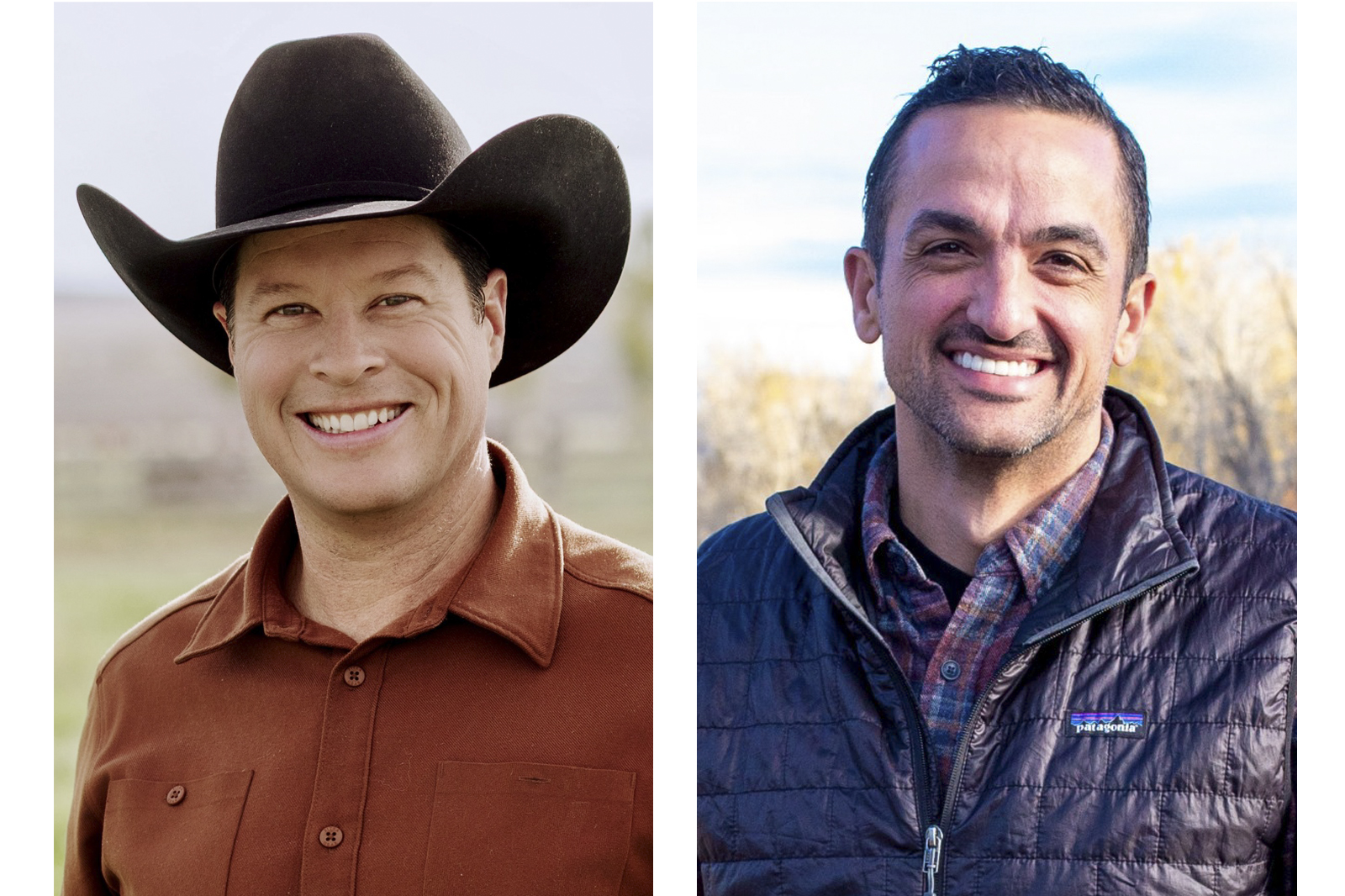
Two Democrats have entered the fray for Montana’s western House district, setting up a primary contest in what many view as the Democrats’ best chance to win a high-profile race in a state that’s shifted increasingly red in recent years.
Russell Cleveland, a rancher and Navy veteran who lives on a family homestead in Saint Regis, will square off against Matt Rains, a West Point grad who most previously worked as the chief of staff for the Montana Farmers’ Union and lives in Simms, just outside the bounds of the western district.
The winner of the (for now) two-way primary will likely contend with a race against incumbent U.S. Rep. Ryan Zinke.
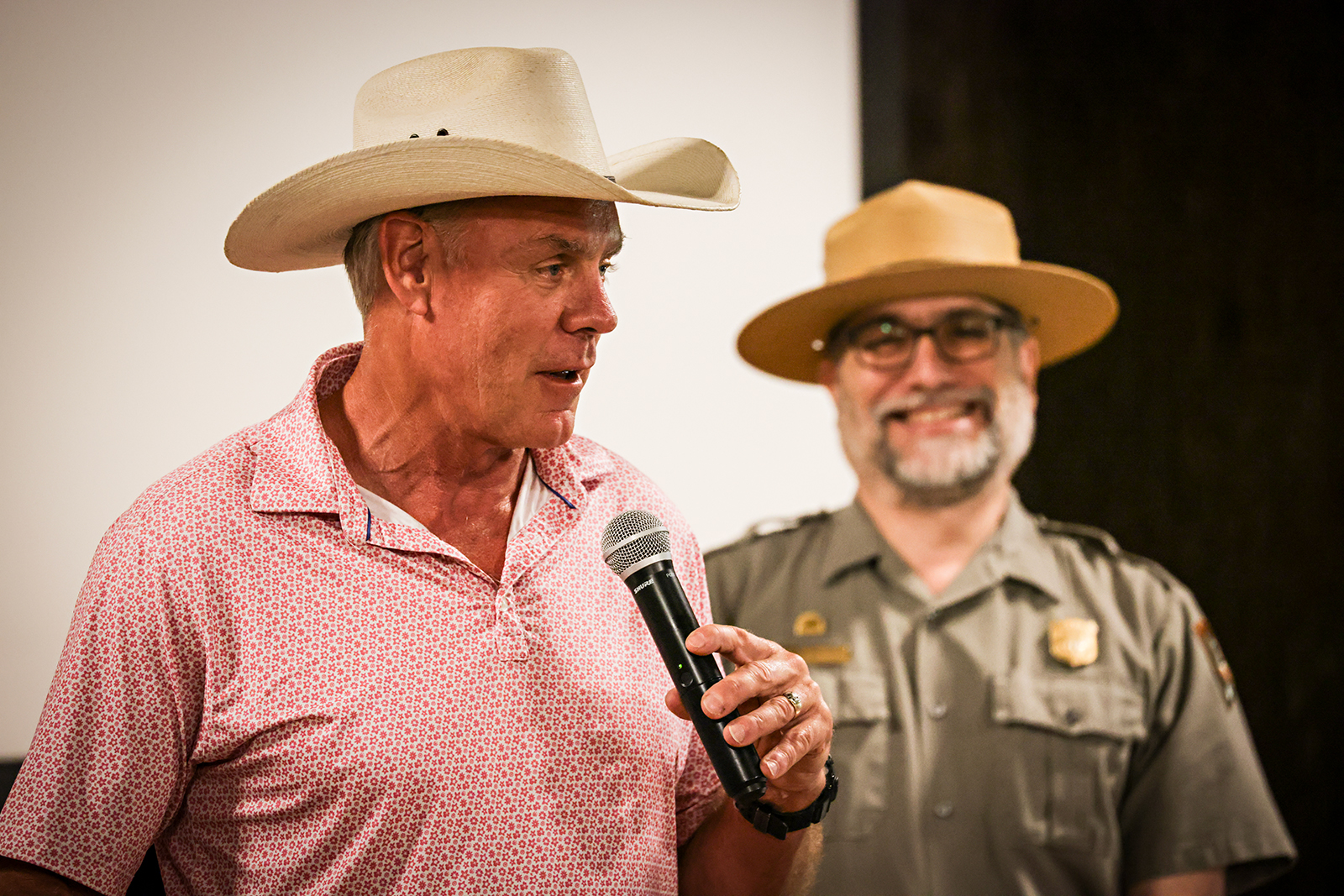
Zinke, a Republican from Whitefish, has served as the state’s representative in the western district since 2023. He won races in 2022 and 2024 against Democratic challenger Monica Tranel. Before that, Zinke served as President Donald Trump’s Secretary of the Interior from 2017-2019, after a stint serving as the state’s at-large congressman from 2015-2017.
He has carved out a brand as a Republican willing to take a stand for public lands issues. Zinke already clinched an endorsement from the president for his re-election at the beginning of November.
“I worked for him as a secretary, and I agree with the direction of the country, you know, looking at putting America first and making sure that we reestablish ourselves as a strong country,” Zinke told the Beacon following the endorsement. “I’m not surprised (by) anybody he endorsed — Jim Jordan, he endorsed myself, he endorsed several members — and I still remain in a circle of trust with the president, and work with the administration as a member of Congress to make sure that we’re successful.”
Russell Cleveland grew up on a family ranch in Stevensville. He earned a scholarship to play football at Montana Tech, where he remained until enlisting in the Navy in 2004. He served as an aviation electrician out of Norfolk, Virginia, until 2009, and eventually finished a degree in electrical engineering at the University of Nevada-Reno. Cleveland also earned a Master’s degree in sports administration and leadership, along with a certificate in executive leadership, at Seattle University before taking a job with U.S. Bank in Denver.
In 2016, Cleveland and his wife founded Rocky Mountain Kids in Colorado. The startup company aimed to fill gaps in quality childcare. The couple ran it until the company merged with a competitor. Cleveland and his family moved back to Montana in 2021. He now coaches football and track in Saint Regis, along with running his family’s ranch.
Cleveland said he felt a call-to-action at the beginning of the year, when the Trump administration announced cuts to funding for medical research. For Cleveland, that issue was personal. He lost a daughter to leukemia in 2020.
It was after those cuts and some studying up on Zinke’s record — which Cleveland disagreed with — that he started touring Montana, spending time on the road and listening to the issues of people in the western district. Several issues cropped up time and time again: health care, cost of living and public lands chief among them.
I think the reason I’m doing this is because I feel like our D.C. politicians especially have really lost touch.
Russell Cleveland
He officially filed for candidacy in April. It’s his first time running for public office.
“What we’ve gotten into as a process is a lot of people have been like, well, you start with county commissioner, and then you go for state legislature and then you go for D.C.’s legislature,” Cleveland said. “And what we end up getting as a product out of that is this career politician. We like to call them that oftentimes, not always a bad thing. But, many times I feel like they have lost touch or potentially don’t necessarily have roots grounded in what it’s like to be a middle- or lower-class Montanan that has you know, from my experience, as a veteran, or has a family they’re trying to raise here, or has run a small business or really is in touch, I like to say, with what reality we face every day in this state.”




To date, the rancher and Navy veteran has raised $72,019.66, according to Federal Election Commission filings through the end of September. He described his efforts thus far as “grassroots.” His time campaigning has been spent traveling the district, speaking to voters from all counties via public events and town halls.
Cleveland has also pledged to refuse funding from political action committees, throwing his support behind the Transparent Election Initiative. That initiative, currently embroiled in a lawsuit with the attorney general, is a citizen-led ballot initiative attempting to overturn Citizens United via redefining the powers of a corporation in the state.
“I think the reason I’m doing this is because I feel like our D.C. politicians especially have really lost touch,” Cleveland said. “We shouldn’t have to be a millionaire or have millionaire or billionaire backing to represent the people, especially in Montana, where hardly anybody is a millionaire, a billionaire.”
Matt Rains’ roots in Montana run deep: he’s a fourth-generation rancher who graduated from Simms High School. After graduation, he attended West Point and served as a Blackhawk helicopter pilot and officer in Iraq and South Korea. Then, he started a career as a photojournalist covering humanitarian crises.
“I traveled over 60 countries as a humanitarian photographer,” Rains said. “And so, I was in countries from Kenya, Rwanda, Uganda, Kyrgyzstan, Afghanistan, Pakistan, and then I was the first foreign photographer that was in the Rohingya genocide in Myanmar when it first kicked off. So, I’ve seen some s–t.”
When he finished with his stint as a humanitarian photographer, Rains used his engineering degree from West Point to inspect power plants. He also earned a Master of Business Administration from Washington University in St. Louis.
Eventually, he found his way back to Montana in 2017. This year’s primary isn’t his first foray into politics. He challenged eventual Democratic nominee Kathleen Williams for a shot at Montana’s at-large congressional district in 2019.
But he backed off and opted to run for a state House seat when Williams became the apparent choice. At the time, he told the Great Falls Tribune members of the Democratic Party asked him to consider running for a state House seat. Williams lost her race in 2020 to Republican Matt Rosendale. Rains lost to Jasmine Taylor in the Democratic primary for House District 22. He took a position as the chief of staff at the Montana Farmers’ Union, where he remained until jumping into the primary.
… You meet a Montanan and they’re like, ‘damn, that’s just a really good, nice person.’ Honesty and integrity is our identity.
Matt Rains
Rains said he chose to run for office this time around because he has “the grit, determination and experience to properly represent Montana the way we’ve always deserved.”
He’d considered tossing his name back in the ring before. But it never felt like the right time, as the work he was doing with the Montana Farmers’ Union was taking off. With the union in a good place, Rains said the timing finally worked out. He launched his candidacy with a video on X on Oct. 23. A campaign committee for Rains has yet to be updated with regularly filed reports.
Though he is running for the western district, technically Rains’ ranch lies within the bounds of Montana’s eastern half. When asked why he opted to run in the west, Rains said he views himself as well-suited to represent the western district.
“I’m about two to three hours from every city, from Whitefish, Kalispell, Missoula, Butte, Bozeman,” Rains said. “For the eastern district, I’m about four to six hours away from half the district. And so, I couldn’t properly be out and represent the eastern half of the district based on where I live. The western side makes way more sense.”
Rains said his campaigning approach will consist of visiting with Montanans across the district and talking to them one-on-one. Important issues for Rains also include affordability and health care. He also pointed to honesty and integrity as cornerstones of his campaign.
“Montana’s got 50 issues that we need to deal with. Like, there’s a lot to work on,” Rains said. “But the one thing that Montanans truly deserve — and it’s what Montanans are known for around the country and the world — like, you meet a Montanan and they’re like, ‘damn, that’s just a really good, nice person.’ Honesty and integrity is our identity.”
While both Democrats may share biographical qualities — like agricultural backgrounds, engineering degrees and military service — distinctions still exist.
Perhaps most prominent in Cleveland’s mind: an accusation that the Democratic Party tapped Rains to run for the western district. Rains pushed back on those claims in an interview with the Beacon. While Rains acknowledged he spoke with high-profile former Democratic officeholders before announcing his bid, he said he doesn’t “live my life for anybody else in terms of being told what to do.”
“I mean, I always, after 2019, I absolutely knew that I wanted to run again,” Rains said. “We were doing some amazing things with Montana Farmers’ Union, and so it wasn’t until this summer when essentially, the absence of Ryan Zinke from Montana and the district, and just the chaos that’s going on nationally in Congress … all this stuff has accelerated to where I can’t sit on the sidelines anymore.”
The dynamic Cleveland attempted to portray — of a grassroots candidate with momentum facing a challenge from an establishment candidate — is a framing at play in several other high-profile Democratic primaries around the country. He also questioned Rains opting to enter the western race, rather than joining the candidates who have filed to run in the state’s eastern half, where he resides. The eastern district — a much longer shot for Democrats to win — has two Democrats who’ve jumped into the primary. They are Brian Miller, a Helena lawyer, and Sam Lux, a farrier based in Great Falls.
“I’m 45 miles outside the district as the crow flies,” Rains said. “Which with that, I mean, 45 miles does not change the core essence of a Montanan. I mean that, distance wise, is not a big deal.”
Still, running for a seat outside of one’s district is not the norm, said University of Montana professor and political scientist Rob Saldin. The state hasn’t seen that dynamic since it gained a second congressional seat in 2021. Saldin said doing so could serve as a liability. It’s something opponents are likely to draw attention to, though constitutionally, the practice is sound.
While Rains said his choice to run in the western district was a matter of proximity, Saldin said another factor at play is likely the seat’s winnability.
“What it would take for a Democrat to win in the east is close to impossible,” Saldin said.
What the candidates agree upon: they both say it’s time to unseat Rep. Zinke. Saldin said that’s a task easier said than done.
While the western district may be viewed as the Democrats’ best shot at a high-profile race, Saldin cautioned it would still be an uphill climb for a Democrat to take that seat, especially against a well-established candidate like Zinke.
“The most recent thing the Democrats love to point to is that (former U.S. Sen. Jon) Tester won in the western district,” Saldin said. “But none of these candidates who are looking to be the Democratic nominee are really comparable to Tester in terms of name and recognition and so forth.”
Montana’s primary election will take place on June 2, 2026. Candidate filing closes March 4.