Whitefish City Council Gets First Look at Growth Policy Chapters
While city council members took no action regarding the policy’s content, several members of the public didn’t mince words in their views on the economic development chapter
By Lauren Frick
The Whitefish City Council got its first official look at the city’s state-mandated update to its growth policy, with city staff presenting councilors one of the document’s most contentious chapters at their Tuesday night workshop.
While city council members took no action nor engaged in discussion over the policy’s content, several members of the public didn’t mince words in their views on the policy and economic development chapter during an extensive public comment period.
Much of the public comment revolved around the implementation of mixed-use development in the policy, with several residents saying diversifying businesses and incorporating mixed-use in the city is the best way to plan for the future. Some community members expressed a distaste for mixed-use, voicing concern with growth and sprawl across the city.
The impassioned, contrasting pleas follow last week’s letter presented to members of the planning commission from Portland-based firm, Crandall Arambula, on behalf of Heart of Whitefish advocating for the elimination of retail in neighborhoods in the growth policy, among other concerns. Heart of Whitefish is a nonprofit organization dedicated to advocating for the economic health and vitality of downtown Whitefish and its small businesses.
“We cannot allow ourselves to be blinded by nostalgia or private interest groups when planning for the next 20 years,” Whitefish High School senior Avery Sorensen said at the workshop. “Growing up in Whitefish, I loved the diversity of local businesses that my brother and I could bike to and enjoy, and over the past five to 10 years, I’ve seen those local businesses that I used to love to visit be bought out or shut down.
“As a kid, if I could not walk or bike to a location, then that location did not exist,” he added. “In its current plan, nixing mixed-use zoning and other such initiatives, we are not allowing children to be able to enjoy those local businesses that made the childhood I had in Whitefish so special.”
Chris Schustrom, who presented Heart of Whitefish’s letter to planning commissioners last week, came to councilors on Tuesday night with the same request, asking for them to consider removing mixed use or policies promoting retail use from the community growth plan.
“Desires have been expressed for a specific use, such as a coffee shop, but a desire is not a demonstrated demand that is supported by market analysis and data,” Schustrom said.
Tuesday night’s workshop was the city council’s first of three sessions to work through the state-mandated update to the city’s growth policy before discussing what changes it might want to make to the document, which is set to start at the end of February.
Alan Tiefenbach, a long-range planner for the city who is also the case manager for the growth policy update, presented the highlights of the policy to councilors, first detailing the document’s introduction and projected population estimates, before outlining the chapters reviewed so far by the planning commission: economic development, environment, natural resources and hazards, and public facilities.
Since the growth policy update process has been marked by disagreement and contention over the direction of the city’s future, a central component in Tiefenbach’s presentation was highlighting city staff and/or public concerns with growth policy edits made by the planning commission.
“There were areas where the planning commission made revisions that staff either had concerns with or didn’t agree with,” Tiefenbach told councilors. “There were a lot of red marks in this document.”
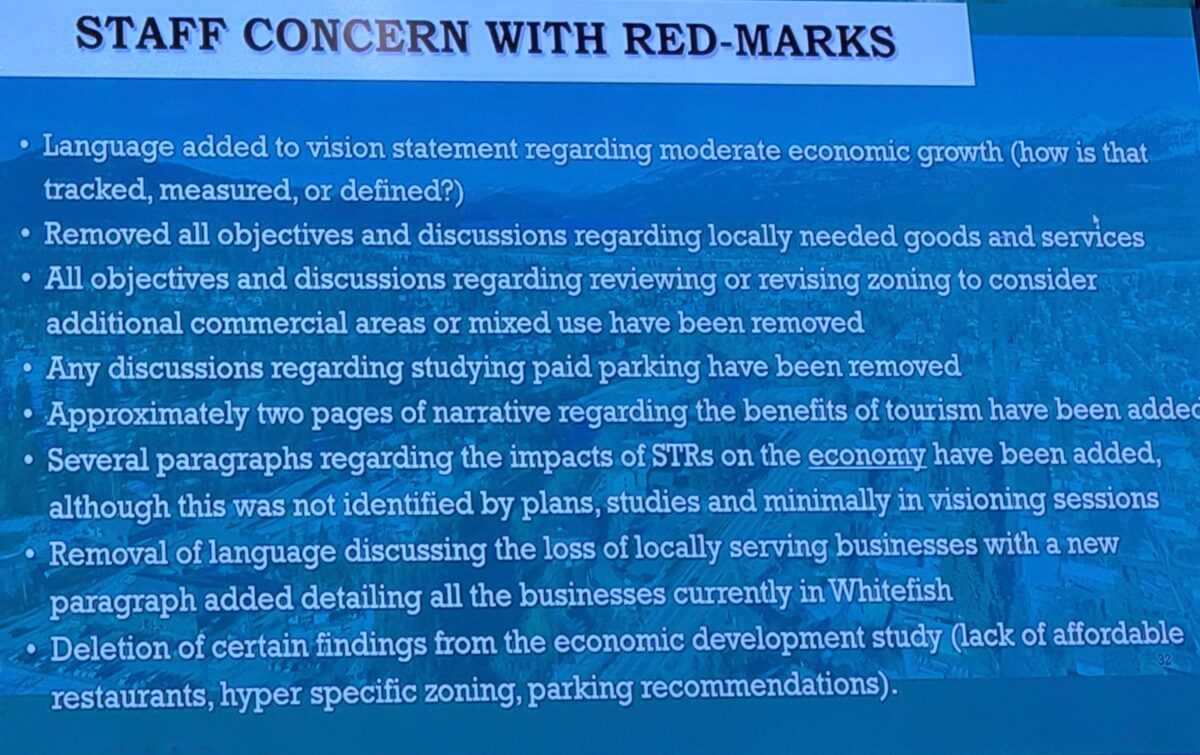
As the chapter with one of the highest volumes of public comment and feedback, economic development saw the most “staff concerns with red-marks.”
The eight concerns with the planning commission’s edits to the chapter highlighted by staff included: removal of all objectives and discussions regarding locally needed goods and services; removal of all objectives and discussions regarding reviewing or revising zoning to consider additional commercial areas or mixed use; and removal of language discussing the loss of locally serving businesses with a new paragraph detailing all the businesses currently in Whitefish.
“Approximately two new pages of narrative regarding the benefits of tourism have been added,” Tiefenbach said. “We’re not debating whether or not it’s accurate. It’s just we wrote this to be somewhat objective, and your policy decision is, do you want to have it heavily weighted towards benefits of tourism? Which is your decision.”
Tiefenbach also included the findings from a consultant study with about 17 commercial stakeholders. Recommendations from the study included: attract more diversity in primary job generating businesses; review whether zoning is too strict; determine if there could be additional neighborhood commercial or mixed-use locations in the city; and consider limiting the number of particular business types in the downtown that are over-abundant.
One of city staff’s concerns with the red-marked economic development chapter is the “deletion of certain findings from the economic development study (lack of affordable restaurants, hyper-specific zoning, parking recommendations).”
Jon Heberling, who was a member of the planning commission until his appointment ended in December, took the opportunity during public comment to share his insights on the editing process of the economic development chapter.
Heberling told councilors the decisions behind the planning commission red-marks of the chapter were rooted in the community visioning sessions, especially regarding prohibiting commercial uses in residential zones.
“With the visioning results, Alan made yellow boxes around 50 comments, and some of them only talked about economics in general or diversity in general,” Heberling said. “Only about six referred to having a coffee shop in a neighborhood or something that would be a commercial use in a residential area.
“As opposed to that was 62 comments which considered loss of neighborhood character to be one of the major threats to Whitefish,” he added. “Small town feel was the number one value selected from the list of values by the visioning participants, and putting commercial into residential areas would be directly contrary to the small town feel that people want to preserve.”