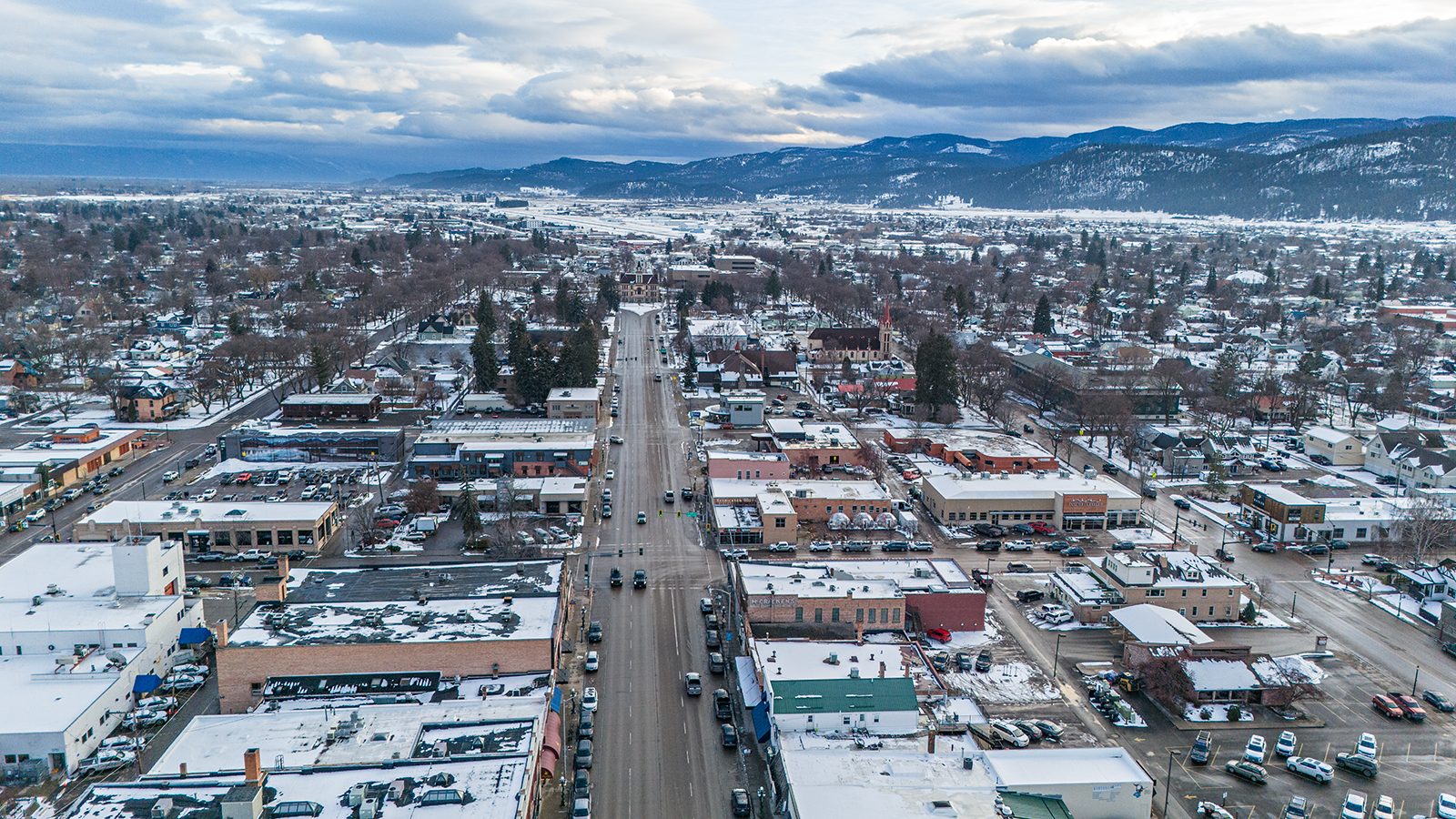
Kalispell City Council adopted the city’s 20-year land use plan Monday night, finalizing a new guiding document to inform decisions about growth, development and annexation. Facing a May deadline, the city was required to update its land use plan to include zoning and housing strategies, per a 2023 legislative mandate prescribed by the Montana Land Use Planning Act (MLUPA).
Councilors narrowly approved the plan in a 5-4 vote after divisions emerged over the inclusion of a map labeling migratory bird habitat west of Kalispell as an “area of concern.” Provided to council by Montana Fish, Wildlife and Parks (FWP), the map depicts a wetland complex that sandhill cranes and other migratory birds regularly use as a stopover site. Conservation groups including the Flathead Land Trust where Mayor Ryan Hunter works identified the area’s wildlife patterns as a concern should future development take place.
At Hunter’s request, FWP officials prepared the map in March with recommendations for conservation strategies the city could adopt in the area, which sits just outside of city limits. After receiving “considerable feedback” on the letter, FWP officials sent a follow-up letter in April to clarify that FWP’s role in the city’s development of the land use plan was meant to be in an advisory role only.
On Monday, Councilors Kyle Waterman, Dustin Leftridge, Lisa Blank, Wes Walker, and Mayor Ryan Hunter voted in favor of adopting the land use plan, as well as an amendment to include the map. Councilors Jed Fisher, Sam Nunnally, Sid Daoud, and Kari Gabriel voted against the resolution to include the map as an amendment to the plan.
Councilors who voted to include the map said it was important to convey all relevant information that could help inform future city growth, noting that the map only serves as a resource and does not place any regulatory designation on the land.
“At the end of the day, the information is there as a way to help people make decisions,” Blank said. “It does not, by itself, make a decision.”
Councilors who opposed the map’s inclusion said they were concerned about “disenfranchising” the current landowners by labeling their property as an area of concern for sandhill cranes and other migratory birds.
“It just totally feels like we’re encumbering on private property rights by heading down this path of labeling something that isn’t even a protected species,” Fisher said.
Nunnally said he had reservations about the data supporting the map considering FWP officials did not provide the map until after the mayor requested it. City staff communicated with FWP last year during the public outreach process for the land use plan, and relayed to council that FWP officials were primarily concerned about limiting sprawl.
“Where I struggle is living and growing up here and seeing what Fish and Game, the local and the federal level, the studies and the time it takes to do that,” Nunnally said. “I cannot forward putting that in without seeing okay, ‘what were the documents behind it?’”
During public comment, some residents said they were unsettled by Hunter’s role as an employee at Flathead Land Trust, a nonprofit organization that works to safeguard community landscapes from development through conservation easements. City Attorney Johnna Preble read a quote from Hunter in a January work session where he said the land would be more valuable and consequently more difficult to include in a future conservation easement if it was included in the land use plan.
After reading through state law and council policy, which includes that councilors should avoid voting in decisions that “could be construed as or take the appearance” of using public office for personal gain, Preble advised Hunter to recuse himself from voting on the land use plan. City Manager Jarod Nygren warned Hunter that his participation in the vote could open the city up to a lawsuit.
But Hunter, whose tie-breaking vote ultimately led to the map’s inclusion and the adoption of the land use plan, said the map’s inclusion did not create a conflict of interest.
“I’m not pretending I don’t work for Flathead Land Trust. I do,” Hunter said. “Nothing about what happens here … benefits the Flathead Land Trust. I think the only thing that will be coming up this evening is mapping the sandhill crane area that they use out there. That has no impact on whether or not a conservation easement happens out there.”