Methamphetamine Contamination Shutters Doors of Trego Elementary School
The contamination, found in the school’s library and in a school-owned property, has resulted in a need for remediation before students can return. The school’s roughly one dozen students completed their year in Eureka.
By Mariah Thomas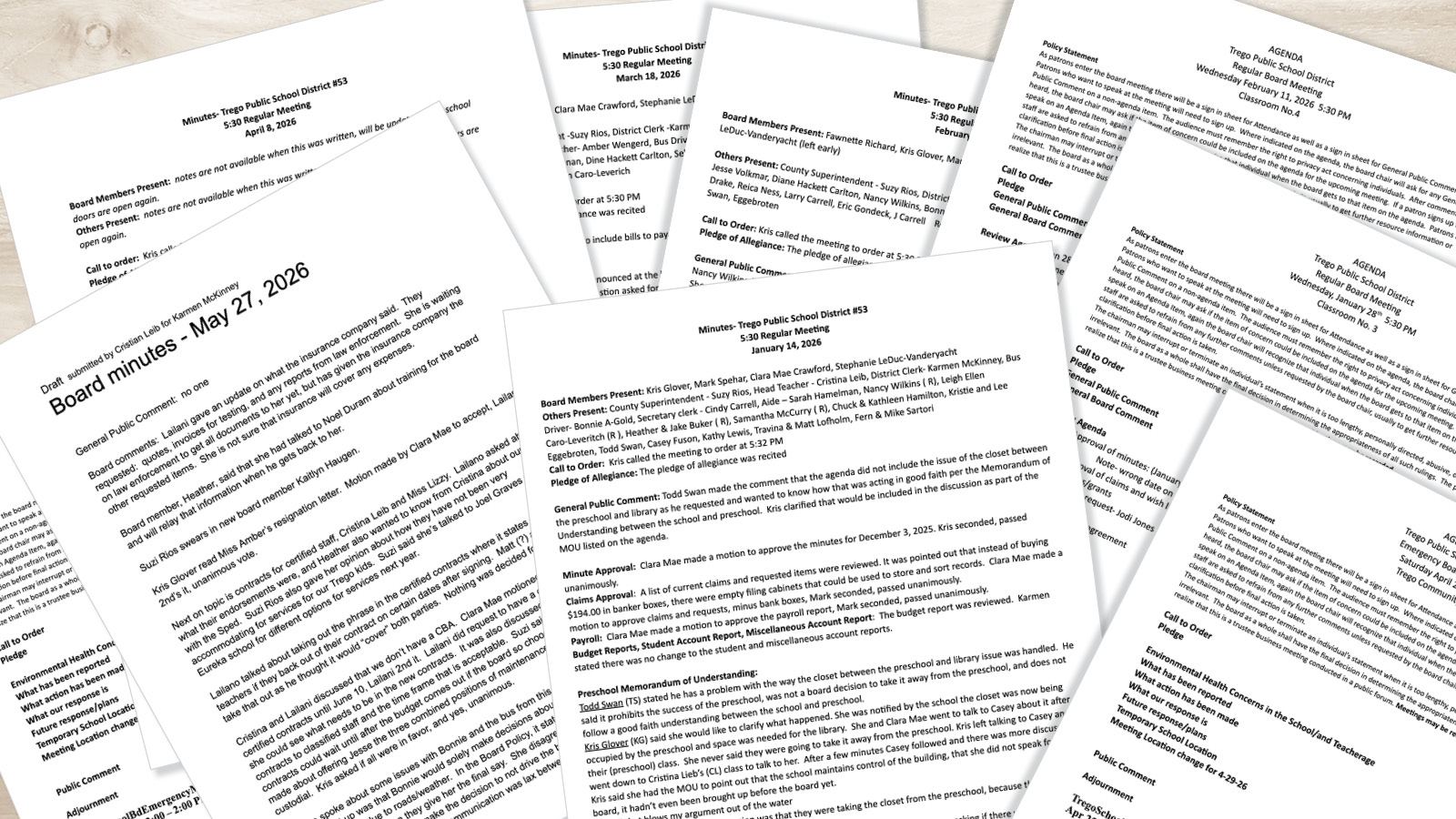
At Trego Elementary School, school board records show a January request from a teacher to rent out a property on school grounds — commonly referred to as the “teacherage” — ended in the school’s closure for the last month of the year, as the K-8 district with roughly a dozen students has spent the spring grappling with revelations that the property and the school’s library tested at elevated levels of methamphetamine contamination.
The first mentions of the teacherage, according to publicly available school board agendas and minutes, came when the school’s newly-hired kindergarten and first grade teacher expressed interest in renting the building in January. For much of February, the board’s discussions about the property appear to have centered on renovation needs and how much the district should charge a tenant for rent.
But allegations emerged in March which, per a recording from the board’s April 8 meeting, had long percolated throughout the community that there had been methamphetamine use at the teacherage. (The Beacon was forwarded a copy of an email sent to the Lincoln County superintendent of schools raising concerns about previous tenants’ activities — a fight that occurred on the property, specifically — dating back to 2024. A teacher at the school wrote in a separate email “rumors from past tenants” had been a point of discussion between herself and a new hire in November of 2025.)
Methamphetamine, a stimulant, is a highly addictive drug, and its prolonged use can lead to cardiovascular damage, neurological changes and dangerous psychiatric conditions, like paranoia and convulsions.
Board chair Kris Glover on April 8 told the board she’d spoken with the school’s lawyers, who recommended testing the property. Glover explained the board could be held liable, since they were aware of the allegations, should they rent the property without testing it. So, the board approved spending $980 for discrete meth testing. It hoped the building would receive a clean “bill of health” from the state’s Department of Environmental Quality (DEQ) at the end of the process.
Instead, the board called an emergency meeting April 25 to present the results of the methamphetamine testing. A copy of the methamphetamine report published in the school board’s publicly available materials stated, “the levels of meth or its known chemical derivatives were found to be above acceptable levels at one or more of the testing locations.” That result requires decontamination and retesting to ensure contaminant levels fall below DEQ’s standards: 1.5 nanograms per 100 square centimeters.
In the teacherage, several tested areas came back far above that standard. Testing showed results ranging from 13 to 280 nanograms per 100 square centimeters in various areas of the rental property.
Afterwards, the board opted to shut down the school building itself for testing. When the library tested above DEQ’s standards roughly a week later, the school shuttered its doors for the remainder of the year.
While testing can determine the presence of methamphetamine residue, it can’t determine how long it’s been there, nor can it determine the source, said a Department of Environmental Quality (DEQ) spokesperson. Residue typically covers surfaces post-cooking or -smoking methamphetamine, according to a report from the National Institute of Health. Methamphetamine residue remains on surfaces “until they are cleaned or remediated,” said DEQ spokesperson Nolan Lister.
“It is largely determined by how porous or exposed the surface is. For example, residue can be easily cleaned from a tile countertop, but can remain on more porous materials like drywall until remediated,” Lister wrote in an email.
Lister also stated there is “limited published information” about methamphetamine residue exposure, especially for children. One study from the Centers for Disease Control states living in a former “clandestine methamphetamine drug laboratory” did come with adverse health effects for those present. There was evidence of methamphetamine absorption among the members of a family that lived in such a home.
After methamphetamine residue is found, Lister said, DEQ helps projects “that either fall under or opt into the DEQ Clean-up Standards” develop a three-stage plan. Those plans consist of identifying rooms where contamination is present, developing a work plan for remediation, and developing a final clearance plan “that involves resampling the areas after clean-up to verify that all areas meet the clearance standard and are safe to be reinhabited.”
Trego Elementary School is in the throes of working through that process. At the board’s May 27 meeting, it approved a bid to remediate the library, with an estimated cost between $12,000 to $16,000. Those funds will come from the district’s building reserve funds, according to board meeting minutes.
Once remediation takes place, the board will have to retest the building for methamphetamine residue. That comes with an estimated cost between $9,500 to $12,500.
The board opted to hold off on remediation efforts for the teacherage, estimated to cost an additional $30,000.
And in the more-direct wake of the findings, the board quickly had to find a solution for its students to finish the year. It was a challenge, as the state’s Office of Public Instruction has “certain requirements for where students attend school,” Cristina Jo Leib, a teacher at Trego Elementary School, wrote in an email to the Beacon.
Superintendent Joel Graves, of Eureka Public Schools, offered up his district’s resources to help Trego’s teachers and students wrap up the year.
Graves said Trego’s teachers used open spaces in Eureka’s high school and at the elementary school library to continue teaching their students. Graves also said his district provided bussing, Chromebooks for Trego’s teachers and helped supplement their curriculum needs, all at no cost to Trego Elementary School.
“We have not charged them anything and we won’t,” Graves said. “It’s a minimal cost with the amount of kids that they have and I’m sure they made some copies and everything, but it’s just something we do as a good neighbor.”
Leib, one of Trego School’s teachers, wrote that Graves and his staff “have been very accommodating, gracious, and helpful along the way.” Leib, who left a career as a teacher after the COVID pandemic, began working at Trego School at the start of the 2025-2026 academic year. She described the discovery of methamphetamine residue in the teacherage and the school as bringing “a lot of dissension, anger, sadness, and a whole lot of deep discussions.”
But Leib also described “resilient” Trego School students who finished out the year as best they could. The school lost one teacher, who did not opt to return for the next school year, and three of its thirteen students finished the year out by homeschooling, Leib wrote. Another student finished the year at Fortine. Nine students continued in Eureka.
“I can tell you that not only did some education happen, but these kids learned a LOT about getting along, dealing with changes, and knowing that the few adults in their lives cared deeply for these kids,” Leib wrote. “In my 30+ years teaching I can say I’ve never had an experience like this. It seems like these 9 months have gone on for 5 years with everything the Trego School has dealt with. I TRULY believe this is going to be the change that so many people, parents, and the community want for this school.”
And change has started already, according to Kristie Eggebroten, who writes for Trego’s Mountain Ear, a volunteer-run news site that has followed the fallout of the findings. Eggebroten told the Beacon eight people ran for the school board’s three open seats this spring. She described it as an unprecedented number of candidates in the small, unincorporated community. The board swore in three new members — Leilani Swan, Kaitlyn Haugen and Heather Brannan — at its May 13 meeting.
Still, questions remain.
Public commenters at the board’s meetings have found themselves at-odds with a school board they claim has been “negligent.”
Minutes from a May 4 emergency meeting show community members asking the district who was responsible for the methamphetamine contamination. Per those minutes, the board adopted the posturing that it could not definitively offer up an answer. In previous meeting recordings, some had mentioned rumors about previous teacherage tenants, while others worried doing so was defamatory.
The sheriff’s office will not investigate the matter. Lincoln County Sheriff Darren Short told the Beacon it was being handled internally by the district, and the tenants who had allegedly used methamphetamine in the teacherage had moved out “long before.”
The Beacon reached out to Glover, the board chair, along with the school district’s clerk and the Lincoln County superintendent of schools, Suzy Rio for comment. Glover responded to a public records request for board meeting minutes from meetings in May and the bid packet for remediation. Those documents were made publicly available June 5, after the public records request was filed.
None answered questions about the timeline for remediation or whether the district is conducting an investigation.