Commission Approves Conservation Easement on Thompson River Timberland
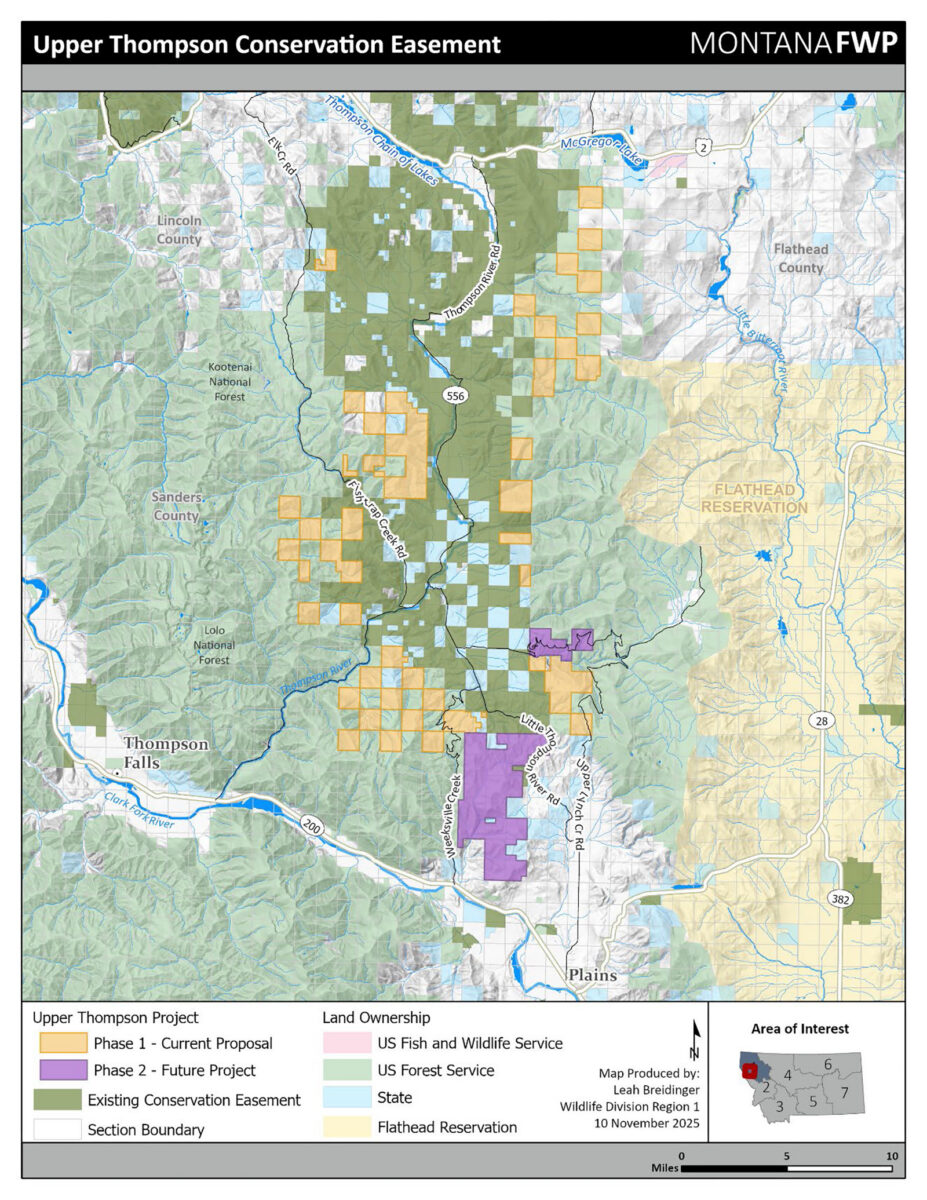
Montana Fish, Wildlife and Parks will move forward with the first of a two-phase purchase that restricts development and protects access on 47,907 acres of working forest owned by Green Diamond Resource Company
By Tristan Scott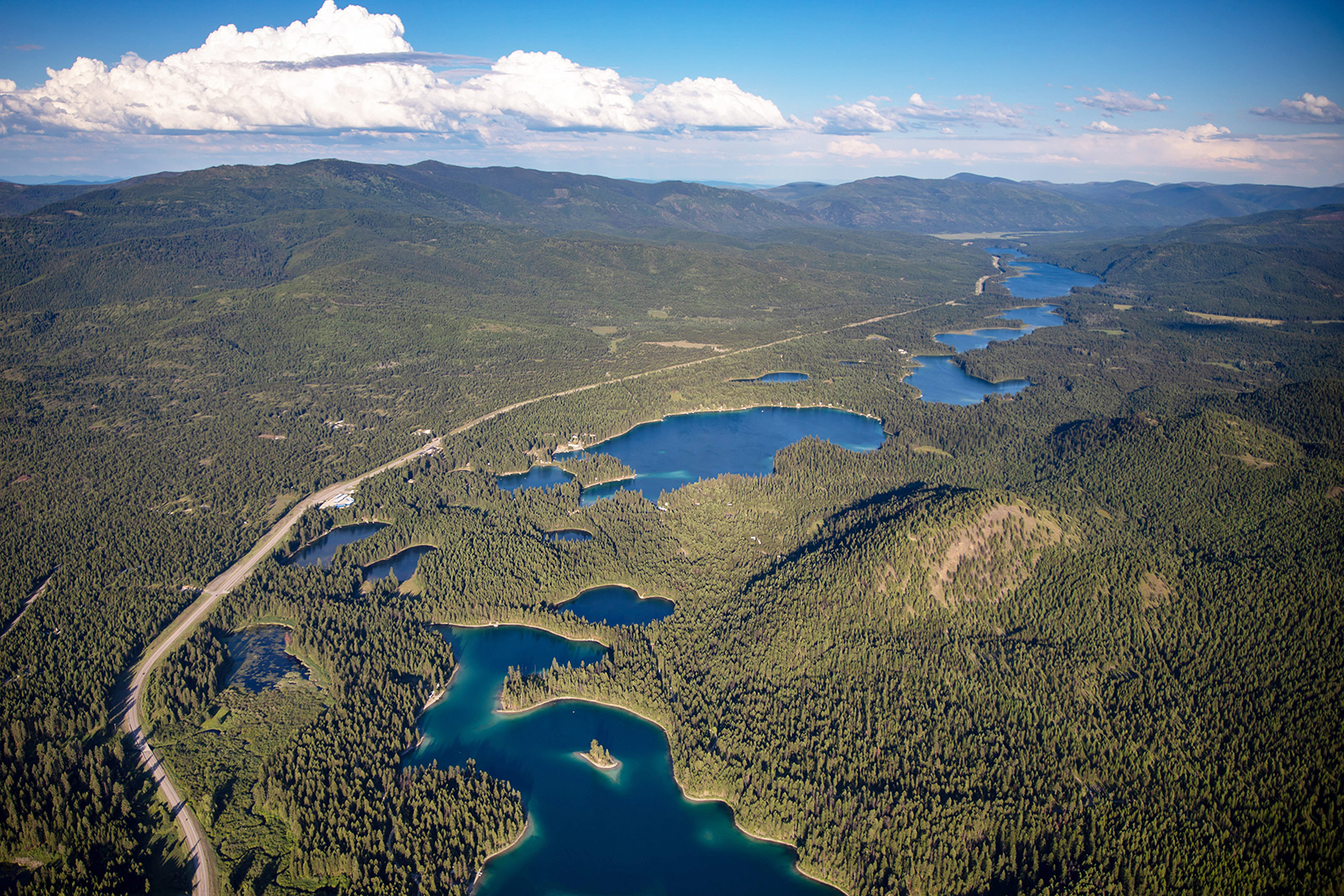
The initial phase of a project to secure public access and remove development rights on 47,907 acres of private timberland in the Upper Thompson River drainage moved forward last week when the Montana Fish and Wildlife Commission approved the purchase of a conservation easement.
On June 12, the commission’s unanimous vote in support of the project authorized Montana Fish, Wildlife and Parks (FWP) to buy a 34,610-acre easement in the Thompson River drainage bordering the Cabinet Mountains. The approval marks “a significant achievement in preserving the iconic landscapes and outdoor traditions of northwest Montana,” Amber Steed, FWP’s Region 1 supervisor, said in a prepared statement Tuesday.
“We appreciate all the time, effort, and support put forth by the landowners, our community partners, and the public,” Steed said. “This project helps safeguard wildlife corridors and ensure that families get to enjoy these lands for generations to come.”
Known as Upper Thompson Conservation Easement, the project is located north of Thompson Falls and Plains in Flathead and Sanders counties. The land is owned by Green Diamond Resource Company, a family owned timber firm that in January 2021 acquired 291,000 acres of working forestland in northwest Montana, becoming the third owner in less than a year to take over management of one of northwest Montana’s most valuable commodities.
The property has historically been owned by mining and timber companies. But in 2020, a fire sale touched off a succession of ownership changes that cast a cloud of uncertainty over the future of the region’s timberlands, as well as the recreation and access opportunities they’ve historically afforded to hunters, hikers, and anglers.
Despite the changes to ownership, public access to the property is currently allowed through short-term block management agreements and voluntary open land policies, under which the land has been managed for de facto public access for more than a quarter century.
“In FWP Region 1, private lands like these contribute significantly to hunting opportunities,” according to the agency’s environmental assessment (EA). For example, over the past five years, 42% of elk reported at game check stations were harvested on privately owned land, according to the EA, which estimates that the Upper Thompson Conservation Easement property provides 10,000 days per year of hunting and angling use.
Although neither free public access nor prohibitions on private development interests were ever guaranteed, Green Diamond has demonstrated a strategic interest in completing several interlocking conservation projects across its checkerboard of land ownership that do just that.
Representatives of Green Diamond said it’s in the company’s best interests to remove the development interests on its land and allow the trees to regenerate in a region that’s still recovering from the effects of legacy logging. That’s why Green Diamond donated 34% of the land’s value to the state’s purchase of the conservation easement, the company’s president said.
“At Green Diamond, we believe sustainably managed working forests are essential — not only for providing vital forest products, but also for delivering clean air, clean water, and valuable wildlife habitat,” said Douglas Reed, Green Diamond’s president and chair.
The appraised value of the first phase of the Upper Thompson Conservation Easement, which covers about 75% of the two-part project’s total acreage, is $20.56 million. Secured funding amounts and sources include: $13 million from the U.S. Forest Service’s Forest Legacy Program, $225,000 from the National Fish and Wildlife Foundation, $200,000 from the Montana Fish and Wildlife Conservation Trust, and $175,000 from private fundraising coordinated by the Trust for Public Land. Green Diamond will provide just under $7 million of in-kind contribution in the form of donated land value, or roughly 34% of the conservation easement value.
Under the terms of the easement, Green Diamond will maintain ownership of the land while continuing to sustainably harvest wood products while FWP will own the easement.
In an effort to preserve the land as an asset for recreation, wildlife habitat and timber production, FWP has been working with private and nonprofit interests to stave off development pressure and furnish the acreage with permanent protections. The project is the culmination of a multi-year effort by FWP, the nonprofit Trust for Public Land and landowner Green Diamond.
This proposed easement complements other large conservation efforts in the area including the 85,752-acre Montana Great Outdoors Conservation Easement (FWP), the 142,000-acre Thompson-Fisher Conservation Easement (FWP), and the 100,000-acre Lost Trail Conservation Area (USFWS). The proposed project was reviewed and approved by the Montana Forest Action Advisory Council in 2021.
“The new easement supports populations of elk, moose, deer, mountain lions, black bears, and a variety of other wildlife, and the property currently provides approximately 10,000 days per year of public hunting and angling use,” according to FWP.