Businesses Report Flat Summer Tourism Despite Inflation, Smoke and Airport Runway Closure
Economic headwinds have triggered a shift in spending trends as visitors seek low-budget trips while weather, the airport runway rehabilitation project and Glacier Park’s new entry system have caused fluctuating visitation patterns
By Maggie Dresser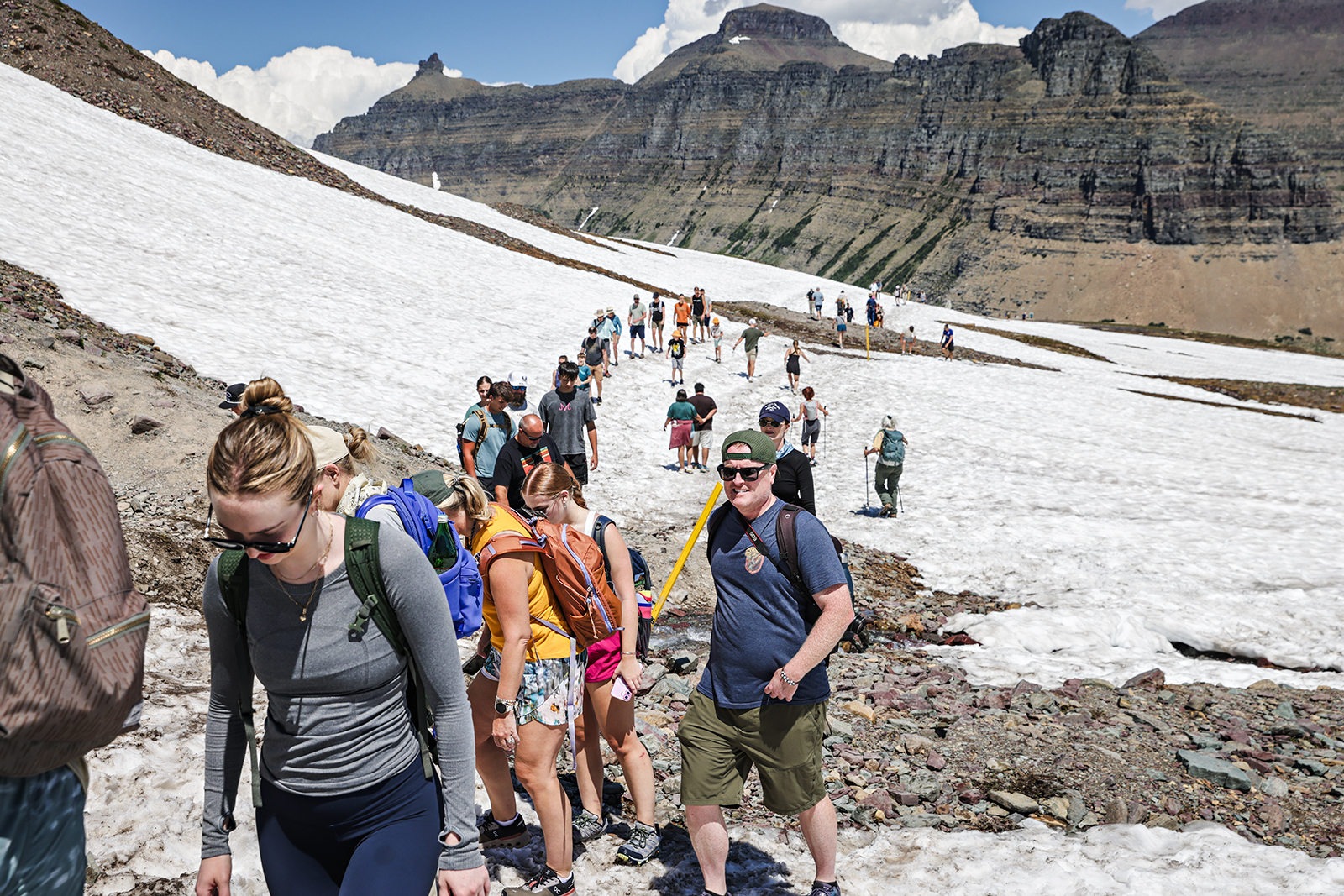
In August, when an active wildfire season in the Pacific Northwest choked the Flathead Valley in a dome of smoke, Glacier Guides and Montana Raft owner Denny Gignoux started getting cancellation requests and noticed lower demand for rafting and hiking trips at his outfitting business.
While the smoky skies deterred some visitors from traveling altogether, he said the guests who did pass through West Glacier were more frugal with their spending compared to previous years.
“Things started to cool off, and we saw guests who were more cautious with how they spent their money,” Gignoux said. “The spending per guest was down and there were a lot more last-minute bookings and cancellations.”
Gignoux also noticed a slight dip in July when Glacier Park International Airport closed its main runway on weekdays for a rehabilitation project, with potential customers relaying to him that logistics would be prohibitive.
Overall, Gignoux said revenue was flat compared to last year with some aspects of the outfitting business in higher demand than others. But inflation, he said, is adding to his overhead expenses while consumers are simultaneously pulling back on spending.
“It’s about the same as last year,” Gignoux said, referring to revenue. “But on top of this, costs are going up. Fuel, property taxes, food, equipment, payroll — all of that is going up and the visitor is price conscious. It’s hard to pass that on.”
Explore Whitefish Executive Director Zak Anderson said business owners generally reported a flat tourism season, which was met with relief as concern over inflation and a shaky economy loomed.
“We had a pretty solid summer considering economic headwinds,” Anderson said. “The plus side is we did have a classic Flathead Valley summer. We are seeing visitation in Whitefish trend back to pre-pandemic levels, which is good for everyone. It’s busy but not too crazy.”
Clare Goble, who oversees Mackenzie River Pizza, Craggy Range Bar and Grill, Ciao Mambo and Latitude 48 with Glacier Restaurant Group, reported a shift in sales. Tourists this year gravitated toward the cheaper restaurants while the more expensive dining options saw flat sales.
“There was a shift in the clientele,” Goble said.
At local hotels, year-over-year hotel occupancy in Whitefish was up compared to last year, while Kalispell Chamber of Commerce CEO Lorraine Clarno reported similar demand in the lower valley. Much of hotel revenue growth, however, was driven by higher rates, not increased volume.
Businesses owners also reported a slight dip in revenue this July, which was likely impacted by the airport runway closure.
According to Montana Department of Transportation aviation data, there were 53,436 boardings at Glacier Park International Park Airport in July, a nearly 39% year-over-year decline. There was an 11% year-over-year spike in June and a 3.6% increase in August.
While July’s air traffic numbers contributed to a drop in travel, they likely represent only a small slice of total visitation since the majority of travelers drive to Montana.
According to the University of Montana Institute for Tourism and Recreation and Research data, only 14% of visitors in 2024 arrived by plane, while 74% traveled by car and 11% by RV or trailer.

Despite the flat tourism season, Glacier National Park is on pace to break the annual visitation record after reporting in September a 10% increase compared to last year. August drew 828,126 visits, which was up 15.2% from a year ago.
The spike, driven by the discontinuation of Glacier National Park’s ticketed entry system, likely reflects changing travel behavior following five years of a vehicle reservation requirement. This year, a reservation-based alpine transit system and a three-hour parking limit at Logan Pass were implemented instead to manage congestion on the 50-mile Going-to-the-Sun Road.
Because of the entry system change, Anderson said the park’s visitation does not reflect tourism outside its boundaries.
“While Glacier Park visitation is [potentially] going to break a record, that doesn’t necessarily mean Whitefish is going to break a record,” Anderson said.
Canadian visitation, meanwhile, has fluctuated in recent months as a weak currency and tense border relations continue to limit international travel. Passenger vehicle crossings at Roosville, near Eureka, rose 15% in July compared to the same month in 2025, boosting the number from 2024 levels. But crossings in August dropped again to levels 20% below 2024.
“We started to see a nice uptick,” Clarno said, referring to border crossings. “We are very excited about that but the last month or so we’ve seen it stall.”