As Developers Flock to Columbia Falls, City Unsure of Wastewater Plant Capacity
Conflicting estimates of the plant’s maximum capacity show two different paths forward as the city develops in the coming years
By Lauren Frick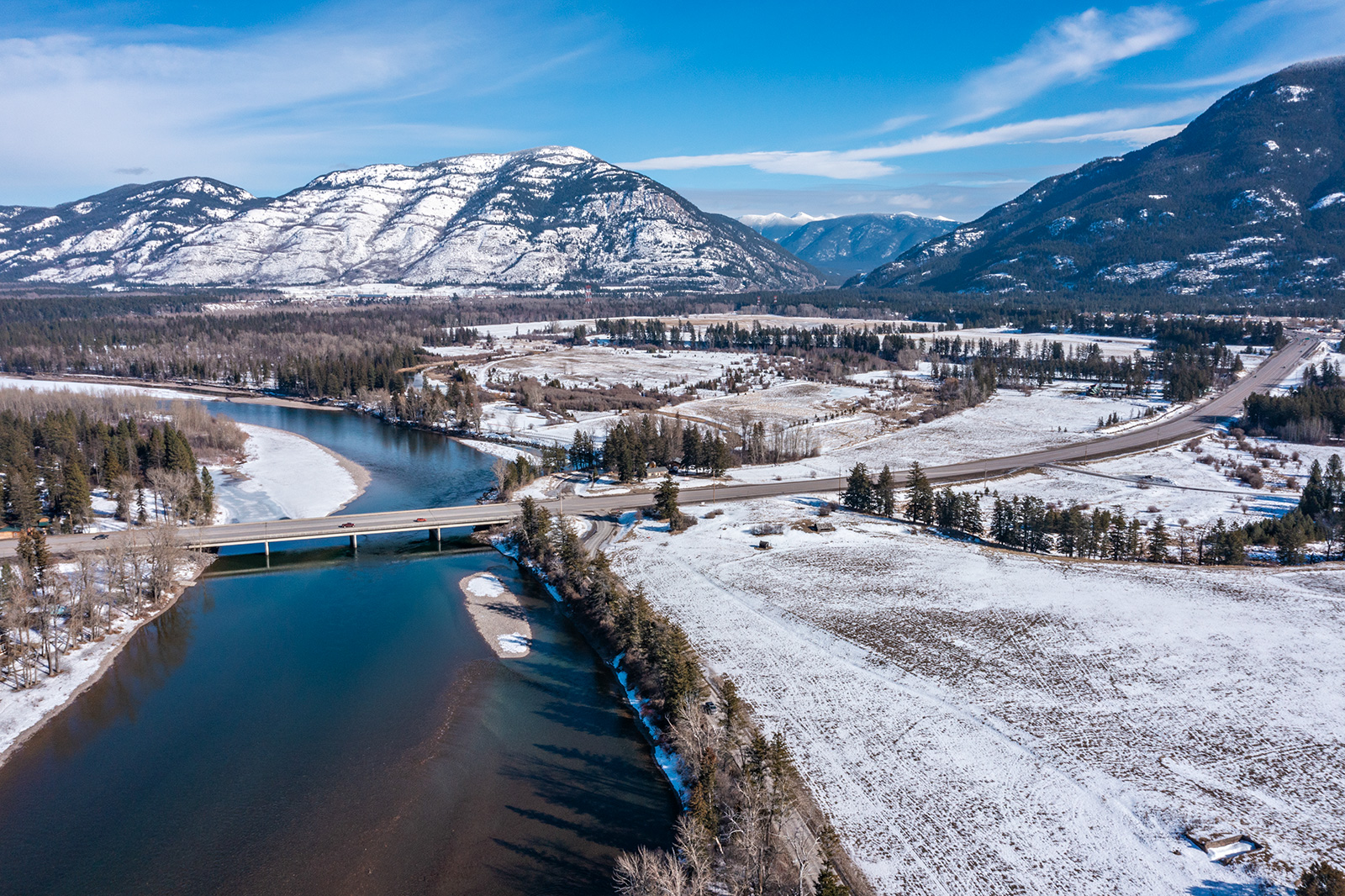
A historic 2022 rainfall event has Columbia Falls officials unsure of the maximum capacity for its wastewater treatment plant — an issue becoming increasingly pressing as development permit applications equating 2,100 people wait in the wings.
In reports to the planning commission and city council this month, City Manager Eric Hanks told officials that factoring the flooding of the Flathead River in June 2022 into the estimated maximum capacity for the current wastewater treatment facility would hamper the city’s room for population growth to roughly 816 people. Seeing the flooding as an anomaly and removing its metrics would boost the city’s wastewater capacity for population growth to 1,894 people, he said.
Either way, the city’s current wastewater infrastructure would still be short of the roughly 2,100 people accounted for in approved and current/near-term development applications, Hanks told council members at their Dec. 15 meeting.
“I’ve been working extensively on this problem trying to get a good estimate of where we are in our wastewater capacity,” Hanks said. “We’ve also seen growth and development applications come in over the last three or four months that will challenge our available capacity, regardless of what those calculations are.”
Hanks, however, reassured councilors and the community that the wastewater plant capacity being discussed refers to the removal of nitrogen and phosphorus from the material, not handling the liquid content, he said.
“Our hydraulic capacity at the plant and for the equipment is in the 2 million gallons-a-day range … so there’s no fear of overflowing the tank or something like that,” Hanks said.
Limited availability for nitrogen removal as the city grows is still cause for concern, however, since the city’s wastewater plant discharges directly in the Flathead River, meaning it’s held to a high standard by the state on its nitrogen discharges.
Columbia Falls discovered its capacity quandary through its state-mandated update to its growth policy — a planning document intended to guide the city through growth and development over a 20-year-period.
In May 2023, the Montana Legislature adopted Senate Bill 382, which created the Montana Land Use Planning Act (MLUPA). Under the statute, 10 cities across the state, including Columbia Falls, Whitefish and Kalispell, are required to adopt a new land use plan and update local zoning and subdivision regulations in accordance with both MLUPA and the land use plan to accommodate for the city’s projected population growth.
To comply with MLUPA requirements, the city contracted Morrison-Maierle Engineering to complete a Preliminary Engineering Report for the wastewater system to determine maximum monthly flow calculations to support the city’s population growth.
Just two years earlier, HDR Engineering released a “basis of design” for a roughly $4 million bioreactor expansion project, which was completed this fall and aimed to increase its capacity to treat nitrogen in the water.
The bioreactor expansion design excluded the June 2022 record-setting rainfall and associated flooding from its calculations, setting up two vastly different findings between the 2023 design and 2025 preliminary engineering report.
The 2023 calculations projected the plant’s maximum monthly flow to be 0.71 million gallons per day (MGD) for a service population — which includes both the city and Meadow Lake Water and Sewer District — of 8,174.
In contrast, the 2025 report, which included the 2022 rain event, found the plant’s maximum monthly flow to be 0.63 MGD for a projected service population of 7,392 — a nearly 800-person decrease, according to city documents.
Now the city and engineering firm must decide whether to reconfigure the 2025 results to exclude the June 2022 rain event and add nearly 1,000 people to the plant’s projected growth capacity.
“I’d hate to see an engineer’s design on the PER (preliminary engineering report) essentially shut down our growth,” Mayor Donald Barnhart said on Dec. 15.
City staff will continue to work with engineers at Morrison-Maierle, as well as the Montana Department of Environmental Quality (DEQ) to nail down which capacity estimate to use in the calculations, with Hanks saying he could defend the use of both.
Hanks told city council members he’s hopeful to gain some capacity back through the recent completion of the bioreactor expansion project.
“The concentration levels of our fluid going to the Flathead River is much better than before. Because the system appears to be working better … the last two months, there’s potential that we could have increased flows at the facility we have now,” Hanks told the council.
The city in the fall will do a study of the plant as the bioreactor completes its first full year of use, which would provide an additional, more accurate data point to consider in the calculation. With developers knocking on the door now, the city likely won’t be able to wait.
The city has already committed to developments that amount to 540 people of future wastewater capacity. This includes 32 townhomes, 255 people in the Garnier Heights subdivision and 258 people in the Tamarack Heights subdivision, which is planned to have 103 single-family homes, according to city documents.
But in near-term development applications that are awaiting city review, an additional 1,560 people could be quickly figured to the future wastewater plant capacity calculations.
Most of that potential growth is linked to Teakettle Heights — a 421-unit project that would bring 844 more people to Columbia Falls through a mix of apartments (240), townhomes (56) and single-family homes (125), according to city documents. A development of 175 single-family homes, River Highlands, would add 438 people to the city’s capacity.
Many of these developments won’t be shovel ready until 2027, but the next few months are crucial to understanding if and how the projects can move forward without the city exceeding its infrastructure capacity, Hanks said. That means the time for decision-making is now.
While the city staff, engineers and DEQ are working to determine whether to include the June 2022 rain event in its capacity calculations, one thing is certain: the city will still be short of their needed capacity under current development permits.
It will be up to the city council to determine how to proceed forward, whether that means a temporary moratorium on development, prioritizing certain development projects over others, or creating a strategic plan for phased development to gradually increase the plant’s capacity through what will likely be costly improvements.
“This is going to be a hard decision between the engineers and the city staff to come up with that number,” Hanks said. “That’s a technical question, not a political question.
“What types of housing is the political question and how we do it when we come to you with that number.”
While Hanks’ Dec. 15 presentation was only meant to introduce the data and challenges, with decisions expected in the new year, councilors shared their initial thoughts before considering the dilemma over the holidays.
“On one hand it answers a lot of questions we’ve had for years,” Councilor Mike Shepard said. “On the other hand, it’s pretty damn scary.”
Councilor John Piper immediately advocated for using the city’s recent housing study as a guide for the council’s decision-making, noting the handful of hotel room developments shouldn’t be prioritized.
“After approved allocations, we need to prioritize the current, near-term applications according to needs that have been addressed by the housing study,” Piper said on Dec. 15. “I don’t see how we get away from that; we’ve gotta do that.”
Councilor Kathy Price agreed, going a step further to advocate for single-family homes if a specific housing type needs to be prioritized. Ultimately, Price, like several other councilors, acknowledged the weight of the challenge at hand in the new year.
“We need to slow our roll until we can come up with a plan,” Price said.