Regional Wildfire Resource Strain a Concern Heading into Peak Wildfire Season in Montana
The beneficial effects of a late June rainfall are starting to wane across the state as fires in the West rage, draining resources as Montana heads into its historically peak months for wildland fire
By Lauren Frick
Widespread drought and critical fire conditions across the western United States means Montana can expect to continue to see “stiff competition” for fire suppression resources and resource sharing as it heads into its most active wildland fire months.
Wyatt Frampton, the acting state forester for the Montana Department of Natural Resources and Conservation (DNRC), relayed this message in a wildfire report to the state’s Drought and Water Supply Advisory Committee at its meeting Thursday, saying early-season fires in the West — especially “unprecedented” acres burned in Oregon — have already largely extended the nation’s resources.
So far, Oregon has burned 1.78 million acres as of July 29, just short of the state’s 1.93-million-acre record set in 2024, according to data from the Northwest Coordination Center.
“We’ve seen a lot of large fires on the landscape in places that were either not used to it or that fire has started on the ground earlier than the typical fire season might be,” Frampton said. “Colorado and Utah really kicked off the national fire season with some pretty extreme fire behavior, and then as they started to get monsoonal moisture, that activity shifted to Oregon and Washington.”
“I do feel like the term unprecedented gets thrown around a lot, but what’s happening in Oregon right now is truly unprecedented in terms of the fire conditions that they are seeing in the state,” he added. “The number of fires they have on the ground and the fire behavior they’re seeing is just, it’s terrible. There are not enough resources for us to address the problems that they’re having.”
The National Interagency Coordination Center (NICC) located in Boise, Idaho assigns scores to different U.S. regions based on preparedness levels, which are dictated by fuel and weather conditions, fire activity, and fire suppression resource availability throughout the country. Utilizing a one through five scale, as preparedness levels rise, so does the need for incident management teams and suppression resources.
The northwest region moved to the highest level (5) two weeks ago, which Frampton expects to remain for a majority of the summer at this point in time, given the widespread activity, he said.
“What that indicates is that there are not a lot of resources available in the system, and that we have to coordinate extensively to move resources and make sure that they are on the priority incidents that might be there,” Frampton said. “Why do we pay attention to that? Montana, our fire season typically kicks off in the mid to late August and early September for our peak, so what that means is that typically by the time our fire season happens, there’s already significant resource commitments across the country.”
Frampton also noted the large number of active fires in Canada, further illustrating a drain on resources the country typically relies on.
“Often this time of year, Canada will send resources down to us to help, but their entire national wildland firefighting force, similar to ours, is engaged with their own incidents,” Frampton said.
Despite the overall resource strain, Frampton made sure to highlight additional resources made available through the legislature to bolster the DNRC’s fire suppression capabilities this season, including detection planes equipped with thermal imagery and scanning cameras, and an “air attack plane,” which provides on-scene air traffic control.
While much of Montana got a much-needed moisture boost from rain in the final weekend of June — with some parts of the state collecting almost all their monthly rainfall total in the few day span — the benefits are beginning to wane as hot and dry conditions persist.
“The beneficial moisture that we received in June did show a decrease in our expected fire behavior for July,” Frampton said. “The beneficial impacts of that, we start to see wear off for August and in September.”
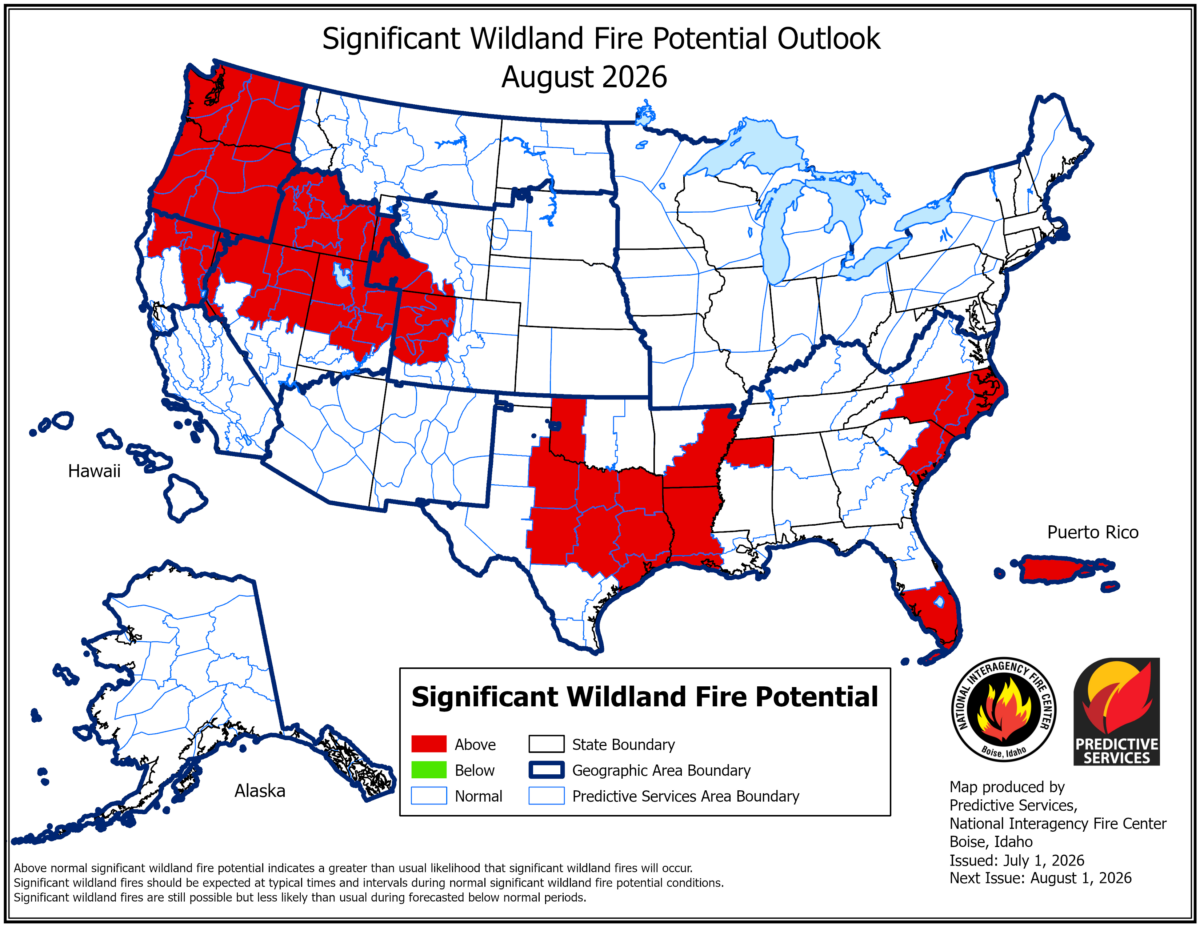
In July, the NICC’s significant wildland fire potential outlook deemed much of northern Montana, especially northwest Montana, at below average risk. The state from August through October as of July 1 is predicted to be at “normal” levels of risk.
“Not being red or being in the white here doesn’t mean that you are not going to have a fire season,” Frampton said. “It’s just saying that at that time, you’re not expected to have significant [fire], so essentially they’re expecting average fire behavior, which for Montana, average for us is several thousand fires and hundreds of thousands of acres burned.”
According to the U.S. Drought Monitor, as of July 28, much of northwest Montana remains the only portion of the state not experiencing any level of drought, with all other regions ranging from “abnormally dry” to “extreme drought.” As of July 23, just under 50% of the state was experiencing at least moderate drought, compared to 65% this time last year, according to data presented Thursday from the Montana State Library.
With any moisture gains the state saw starting to dissipate, a key factor in the coming weeks and months as Montana heads into its peak fire season will be temperature, with Troy Blandford, the water information manager at the Montana State Library, noting the July 12 “broil” that triggered soaring temperatures across the state.
“It’s really about heat,” Blandford said. “Are we going to really stack in a lot of 90 degree days? So far we are seeing a lot of 90 degrees, so that’s what we’re watching closely now.”
While northwest Montana has been seen as a “bright spot” regarding drought and water supply so far this year, dry and hot conditions may quickly degrade those gains, as evidenced by the recent Skillet Fire, which is along the Lincoln and Flathead County line, and 4,136-acre Silvertip Fire in the Bob Marshall Wilderness.
“[Northwest Montana has] really seen their fuels start to behave in a different way in the last week or so,” Frampton said. “We’re starting to see larger fire growth in the northwest part of the state, and then increased resistance to control up there as well.”