Public Weighs In On FWP Proposal to Cut Wolf Harvest Quota in Half
Concerns over the agency’s ability to estimate wolf populations ignited debate as the Fish and Wildlife Commission prepares to vote Wednesday on hunting and trapping regulations for the upcoming seasons.
By Jules Lingenfelter
Ahead of the Aug. 19 Montana Fish and Wildlife Commission meeting, one agenda item has commanded stakeholders’ attention — Fish, Wildlife and Parks (FWP) has recommended a reduction in the wolf harvest quota as part of its proposed Fall 2026-Winter 2027 hunting and trapping regulations, defying a years-long trend of increasing bag limits and setting up a tense debate with Montana’s anti-wolf faction. The proposed cut came as a direct response to FWP’s 2025 annual wolf report that found the agency had overestimated the species’ population by nearly 35%.
Following the closure of the public comment period on Aug. 12, FWP published over 2,000 pages worth of input — many of which questioned the FWP’s ability to properly estimate and track wolf populations.
FWP had previously relied on the Integrated Patch Occupancy Model (iPOM) in tracking wolf populations across the state. The model uses data from various sources, including annual hunter surveys and known wolf locations, to provide estimates on numbers and trends. iPOM estimated the 2025 wolf population to stand at 1,094. After adopting a modified version, which the agency dubbed iPOM 2.0, the estimate stood at 725 wolves.
IPOM 2.0 has yet to be peer reviewed, but a press release from FWP stated that they were “confident in iPOM 2.0 and see it as an advancement in science and modeling.” The agency released both estimates to the public and the Commission alongside a recommendation to reduce the statewide harvest quota to 250 wolves, down from last year’s 450. As per the Montana Wolf Management Plan, the wolf population must be at a minimum of 450 to guarantee at least 15 breeding pairs. Based on the lower estimate, the reduction would ensure the population remained above that minimum.
The discrepancy between the two estimates and lack of scientific peer review for iPOM 2.0 has caused a break in confidence between the public and FWP. But what that discrepancy means in regards to the proposed harvest reduction by 200 wolves varies widely. For some stakeholders, it was far too drastic a measure. For others, it was not nearly enough.
Proponents of wolf hunting and trapping argued that iPOM 2.0’s numbers should not be relied on, and that the Commission should follow the original estimation of over a 1,000 wolves in deciding the harvest quota.
“I’m hearing of a new formula for counting wolves that makes the estimated, but yet unknown, number of wolves much less than previously stated. That concerns me,” wrote Rich Sheets, a hunter from Kalispell. “We need to manage these wolves, control the numbers, they are impacting available game. […] I’m thinking this new math is screwy.”
Many of those who urged the Commission to not reduce the harvest quota cited concerns around livestock and ungulate animal populations. Wolves play a necessary role maintaining healthy levels of elk, moose, and deer in Northwest Montana’s ecosystem. But commenters noted that more wolves risk picking off these populations, and pose stiff competition with hunters. Ranchers further worried what higher presence of wolves could mean for their livelihood.
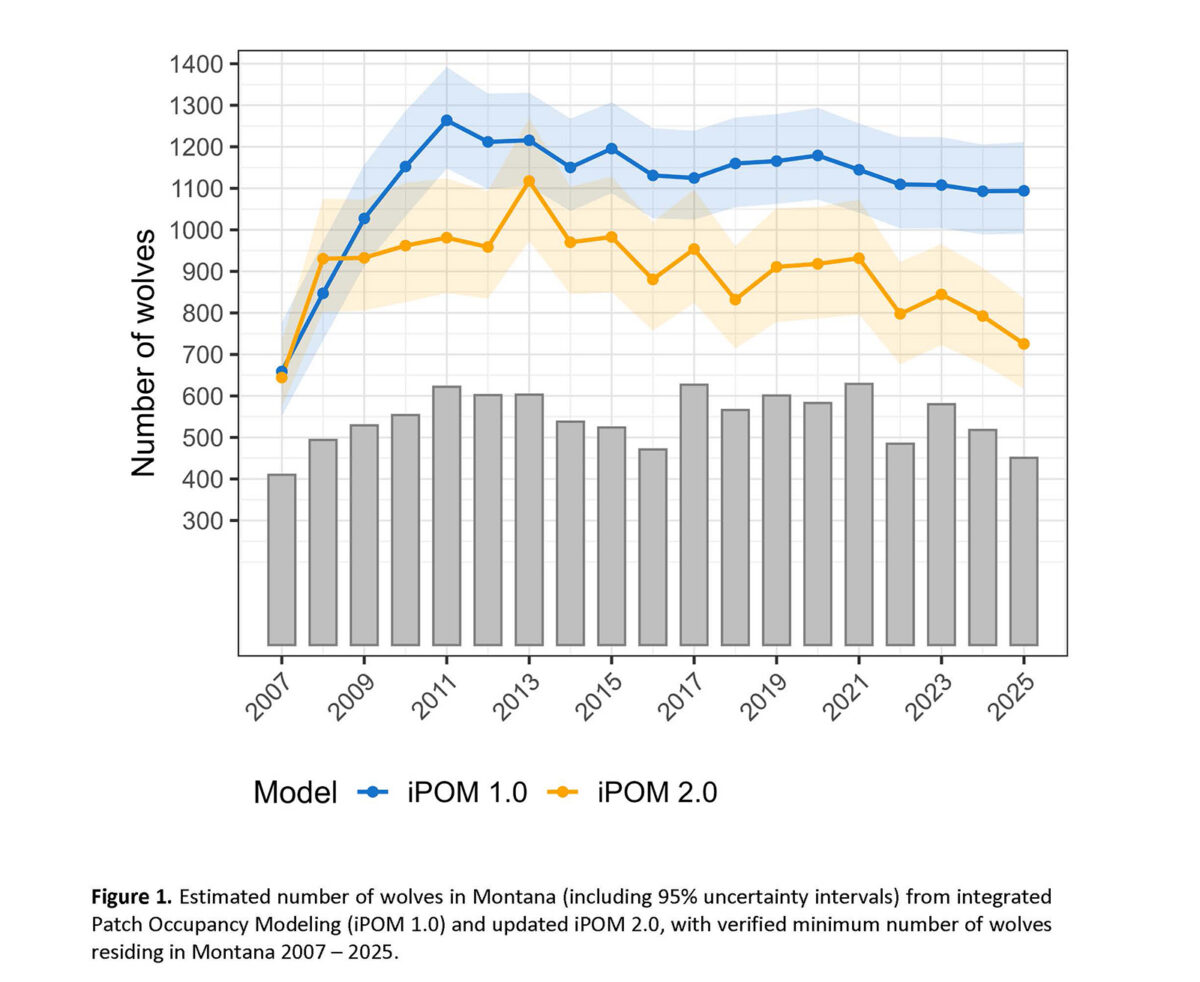
They also pointed to the difference between set quotas and actual harvest numbers. During the 2025-2026 season, 247 wolves were taken. “Lowering the quota seems detrimental as we have not met the state quotas throughout the state in recent years,” wrote Brian Camp, a resident of Libby. “Last season we didn’t even meet half of the quota but yet the state wants to cut the quota in half? It appears to me that the state is attempting to play both sides of the fence.”
On the other side of the fence, many proponents of wolf conservation argued for a steeper reduction in the harvest quota. Commenters pointed out that the reduced quota, while still maintaining the wolf population above the 450 minimum, allows the potential for one third of the population to be taken.
Eileen Schmidt, a Polson resident, wrote, “The agency is nevertheless preparing to gamble with a native carnivore using a population model that has not completed peer review. This is not precautionary wildlife management. Rather, it is an attempt to manage wolves toward the lowest population MT believes it can legally maintain.”
Others, still, demanded a halt in wolf hunting and trapping until FWP could promise more accurate and confident population estimates. Their concern lies in the potential to decimate the gray wolf population enough that it would need to be relisted and federally protected under the Endangered Species Act — effectively undoing decades of conservation efforts that successfully delisted the species in 2011.
Anja Heister and Connie Poten, co-founders of the conservation group Footloose Montana, publicly called for FWP to institute a moratorium on wolf hunting and trapping. “This is no time for recreationally killing 250 wolves struggling to survive,” they wrote in an op-ed published in the Beacon. “At the August 19 meeting, the Montana Fish and Wildlife Commission can and should place a moratorium on wolf hunting and trapping until a transparent, reliable method of ascertaining wolf packs and wolf population health is established. It is the right thing to do in a time of great uncertainty.”
Alongside a reduction in the statewide harvest quota, FWP also recommended a bag limit of ten wolves per hunter and trapper — the previous bag limit was 15. On Aug. 10, Region 3 Commissioner Susan Kirby Brooke proposed an amendment to further reduce the bag limit in certain areas. In Region 3, individual hunters could capture up to five wolves, and in Wolf Management Units 313 and 316, the limit would be decreased to one wolf per hunter. Reducing the bag limit, the amendment’s rationale stated, would allow harvest opportunities for more hunters in the areas, which have smaller subquotas than Regions 1 and 2.
The Commission will decide to reject, modify or accept the proposed wolf hunting and trapping regulations at the Aug. 19 meeting. Though the online comment period has ended, citizens can comment during the meeting in-person at the Montana Heritage Center or virtually by registering online by noon on Aug. 18.