In Deep-Red Flathead County, North Valley Legislative Contests Require Candidates to Compete
While some local politicians point to redistricting, which split the solidly blue city of Whitefish in half, as part of the reason the races are competitive, the north part of the valley has long seen its districts switch partisan hands
By Mariah Thomas
The Flathead Valley’s political makeup is red — deep red.
It delivers the second-highest number of Republican votes in the state. And while Democrats in the Flathead have fielded a full slate of candidates in Flathead County this year, many face contests where Republicans have historically won by wide margins.
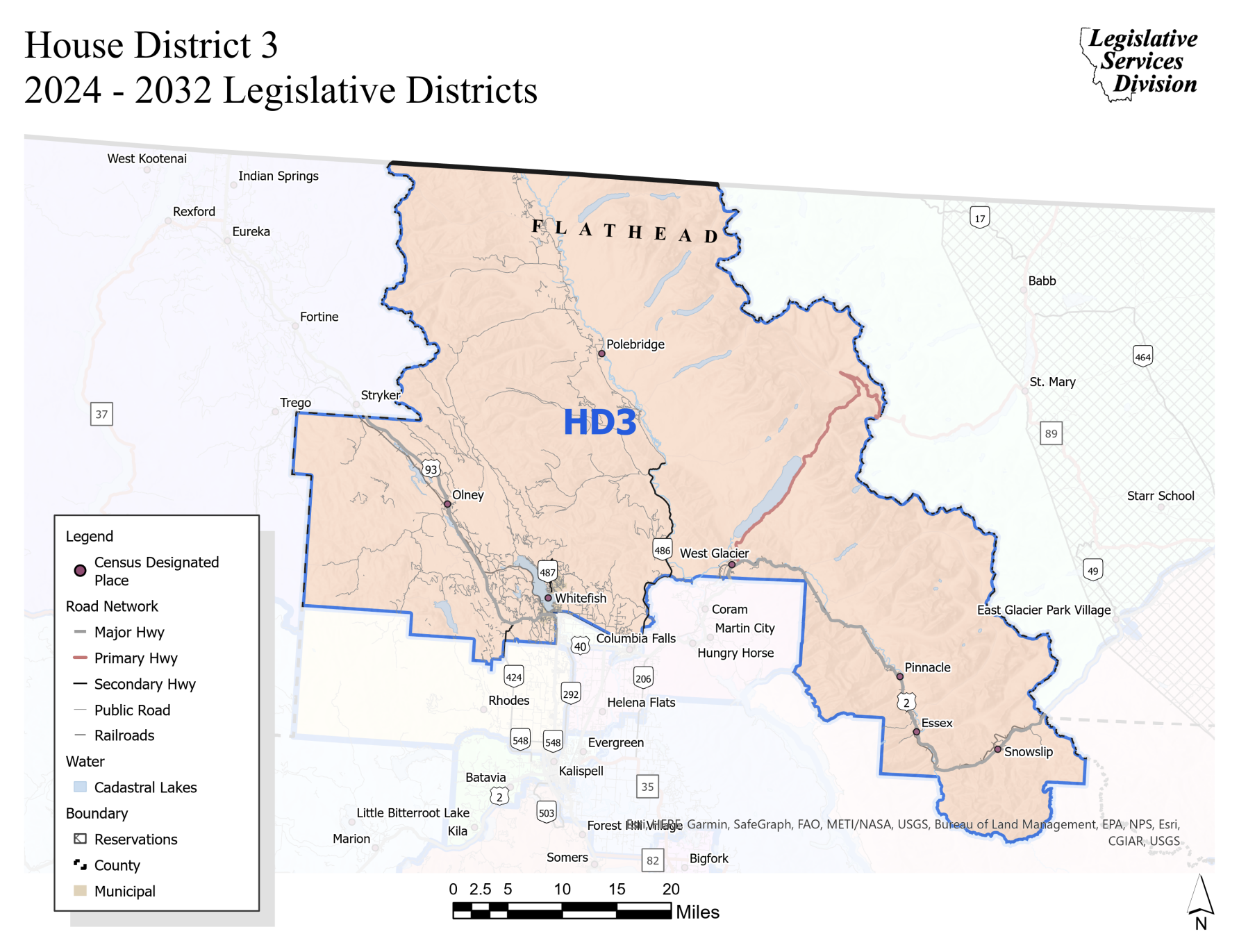
House Districts 3 and 4, each located in the county’s politically ambiguous northern tip, are exceptions to that rule. HD 3 includes parts of Whitefish and northern Columbia Falls, along with Olney, Polebridge, West Glacier and Essex. HD 4 holds part of Whitefish and the majority of Columbia Falls.
While several Flathead Valley politicos point to the 2023 redistricting map, which split the solidly blue city of Whitefish in half, as part of the reason the races are competitive this fall, the north part of the valley has long seen its two state House districts switching partisan hands. It marks a rare dynamic in one of the state’s most Republican corners, one that requires candidates to be more engaged in their campaigning as they aim to home in on issues that truly matter to the voters whose doors they’re knocking on.
Redistricting typically is an “inside baseball” process, said Al Olszewski, formerly the chair of the Flathead County Republican Central Committee. Often, it’s challenging to spot the consequences that come from it without being a highly informed voter or citizen.
But in the northern part of Flathead County, those consequences were apparent in 2024, the first election cycle after redistricting took place, according to Dave Fern, a longtime Democratic legislator hailing from Whitefish. Fern, who had represented House District 5 for eight years at that point, said the district previously contained much of Whitefish before redistricting split the Flathead’s bluest dot in half.
“On paper, it made it a more competitive district, and what you yielded on the Whitefish side was no longer a safe district, but a district that favored the Democrat running,” Fern said. “Then, you put the two together, and it created a Senate district that was competitive. Previously, in the Senate, there were no competitive districts, and by competitive, I mean within just two to three percentage points.”
In 2024, Fern ran for that Senate seat, a seat he won and will hold until he’s up for reelection in 2028. And in the newly redrawn HD 3 and HD 4 that year, each race was decided by roughly 200 votes. Democrat Debo Powers bested Republican challenger Cathy Mitchell in HD 3, while Republican Lyn Bennett wrestled out a win over Lindsey Jordan in HD 4.
“It wasn’t a sure thing that the Democrat was gonna win [in HD 3], and certainly not like Bozeman or Missoula, but it made it possible,” Powers said. “That’s what I think the redistricting commission wanted to do, was make as many districts as they could competitive, so people would actually start to think about the people who are running and what they would bring to the job.”
But in the north valley, it appears, voters already seemed to be making those considerations. The close outcomes in those districts in 2024 are part of a longer history of tight legislative races in that area.
For the past decade, it was HD 3 and HD 5 that contained much of Flathead County’s northern tip. For most of those years, the seats were a lone area of success for Flathead Democrats, and an area that required Republicans to compete in order to win — something GOP members don’t necessarily have to do in other local legislative races, where they often win with more than 60% of the vote.
“I think the biggest problem [for Democrats] in the valley is exposure,” said Ron Gerson, chair of the Flathead Democrats. “The Republicans have an advantage because they are incumbents, so they get a natural media exposure and historic earned exposure. So, for a challenger, that’s way more difficult.”
But in the north valley, Gerson said, Democratic candidates enjoy more visibility because the seats have flipped hands.
Fern, for instance, held HD 5 for eight years, through 2024. And for much of the 2010s, HD 3 was held by Democrat Zac Perry. Perry won a trio of tight races for the seat in 2014, 2016 and 2018 before departing office. At that point, the seat flipped hands to Republican Braxton Mitchell. Mitchell in 2020 won over Powers, the Democrat who would go on to represent the newly minted HD 3 after the 2023 redistricting map fell into place. Mitchell held onto the HD 3 seat for two election cycles, before switching in 2024 to run in the redrawn HD 5, which now contains Hungry Horse, Lake Five, the Glacier Park International Airport and parts of Helena Flats.
Fern and Olszewski pointed to a slew of factors contributing to the north valley seats’ historic and unique competitiveness. Among them: a history of union work in the area, which has in the past lent help to Democrats; a history of activism; and a heavy weight placed on the local involvement of candidates running there.
This year, the candidates running in HD 3 and 4 have leaned into those local roots as they’ve campaigned.
In HD 3, for instance, this year’s contest pits incumbent Rep. Powers, a Democrat and retired teacher, against Republican entrepreneur Derek Peachey. The pair have each proclaimed their prowess as listeners, declined to engage in personal attacks on each other, and heralded their longtime residencies in the district. Neither has emphasized their political party affiliation on the campaign trail. Instead, both have opted to emphasize issues they feel as most in touch with the district’s needs, along with trying to build personal connections with voters.
It’s the right approach to take to voters in the area, said Giuseppe Caltabiano, a Whitefish city councilor and chair of the county’s Republican central committee. As he has run as a right-of-center candidate in the more typically left-of-center Whitefish, he has found success focusing not on divisive issues and party lines, but instead on building human connection. During his first campaign for office in 2021, rather than simply canvassing Whitefish voters by walking up and down each block, he sorted them by their birthdays. He found between 14 and 18 residents had a birthday every day. The city councilor took to driving his Vespa around and bringing a bag of birthday treats to voters’ doors while making his pitch.
Fern, the Democrat who has long won his bids for office in the area, also emphasized the importance of hitting every door and talking to voters in the district. He said he has focused on policy positions rather than political parties in his campaigns, a factor he pointed to as part of his success in his runs for office.
That’s something Powers, the incumbent in HD 3, said she’s done this year, making her pitch that it’s important to consider the person, their backgrounds and their policies over their political party.
“People ask you at the door sometimes what party you are, but I don’t usually bring it up because I figure … Montana has always been a place where you vote for the person, not the party,” Powers said. “And that’s how it always was in Montana until recently, when everything started getting so polarized and people getting in their own camps, and then they just vote for the R or they vote for the D and they don’t even look at the people or the issues. And that’s too bad.”
Peachey has taken a similar approach as he talks to voters this fall.
“I try to focus more on ideas and problem solving than I do party,” Peachey said. “I don’t go to someone’s door and say, ‘hey, I’m Derek Peachey, Republican for HD 3.’ I’m, ‘hey, I’m Derek Peachey. I’m raising my boys here. We live here up the road, and I’m part of your community, and you might find me coaching your kid on the baseball diamond, and I’m running because I want to solve problems around property tax and make sure we’re safe from fires and those things.’”
He continued: “So, to me, I think the partisan divide is more fueled by media and partisan politics than it really is by the real people. I don’t think people care what your party is as much as, are you somebody who’s open to listening and solving problems.”

And in HD 4, which has pitted entrepreneur Shaun Pandina against educator Paula Koch, both have also hit the doors hard. That’s important, Olszewski and Caltabiano said, because the candidates who show up and talk to voters are those who do well in the swingy districts. Ultimately, according to Fern, it also serves voters well.
“I think for the consumer, the voter, it’s really a good situation to have competitive races where if you want to win, you need to get out there and you need to talk to people, kind of like that old-style retail politicking,” Fern said. “That brings it back home and lets people make more informed decisions, and I see that as good.”
Fern lauded the candidates running on both sides of the aisle in HD 3 and HD 4 this year, suggesting it seems as if all four have been dedicated to the task of campaigning.
Still, the competitive dynamic is one Koch, the Democratic candidate for HD 4, characterized as “tricky.” While she acknowledged the same point Fern made — that it does allow voters to get to know the candidates better — she also said it’s challenging for candidates to have time to learn how to do the job they’re asking for.
“Don’t get me wrong, I’m learning constantly,” she said. “I’m constantly on Zoom meetings. I’m constantly going to tax reform and information. But your candidate has to spend over a year campaigning. So, would you rather have them really putting all their energy into investing more time in reading about tax laws, writing bills, being creative, being able to sit down and meet with your community members to develop legislative actions that would be ready to go November 4, the day after the election? So, what’s unique about a competitive race is the amount of time a candidate has to spend campaigning versus, I guess I would say, investing energy in research and learning.”
Ballots were mailed to absentee voters Oct. 9. Election Day is Nov. 3. Voters can check their registration status and the status of their ballot here: https://voterportal.mt.gov/WhereToVote.aspx. To register to vote, voters can either bring their completed voter registration application to their county elections office or visit their county elections office to fill out a voter registration application and receive a ballot there.
Lauren Frick contributed reporting.