FWP Unveils Second Phase of Project to Preserve 85,000 Acres of Private Timberland in Flathead, Lincoln Counties
The state agency is accepting public comment on a conservation easement that would keep the land in timber production while maintaining public access and protecting fish and wildlife habitat
By Tristan Scott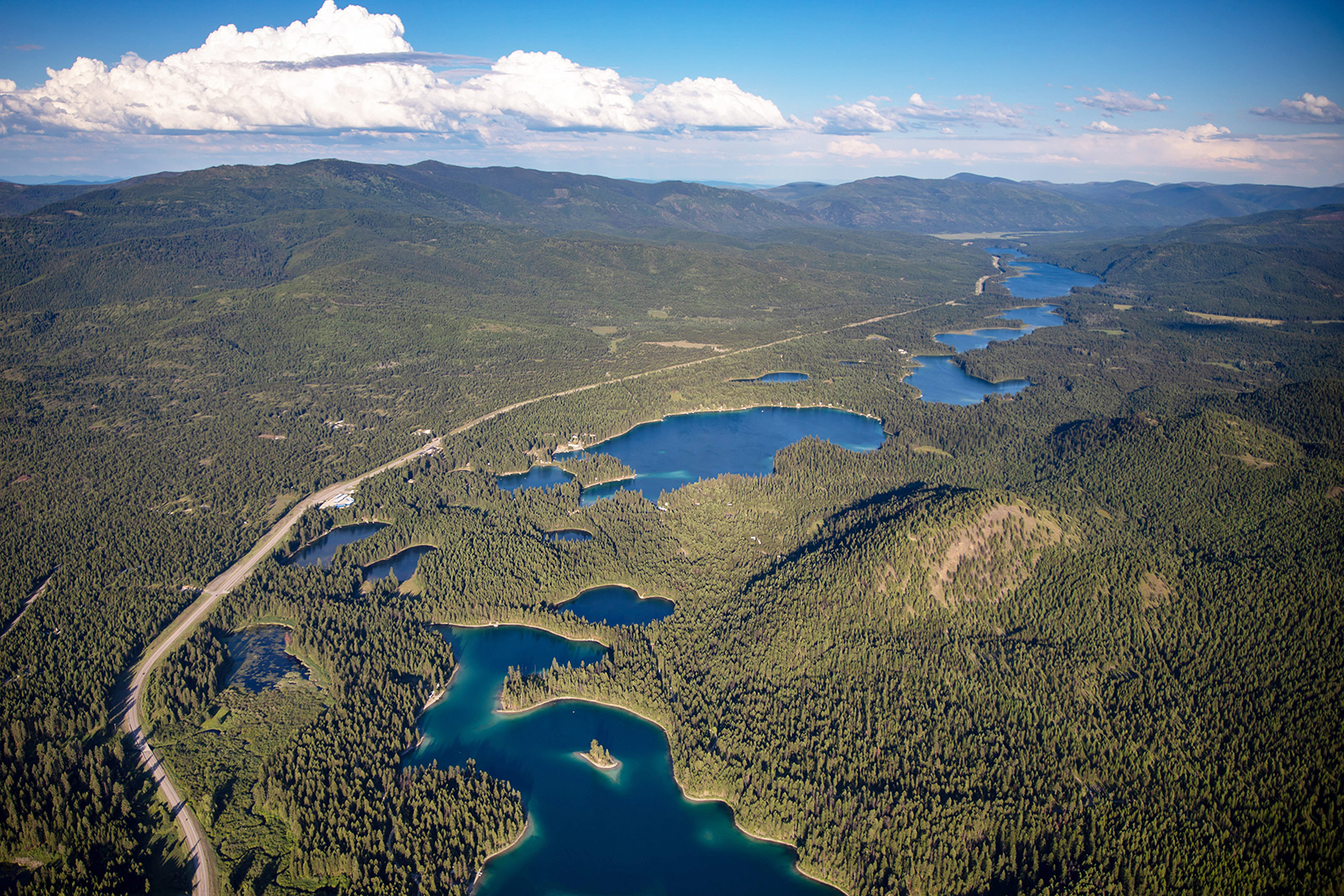
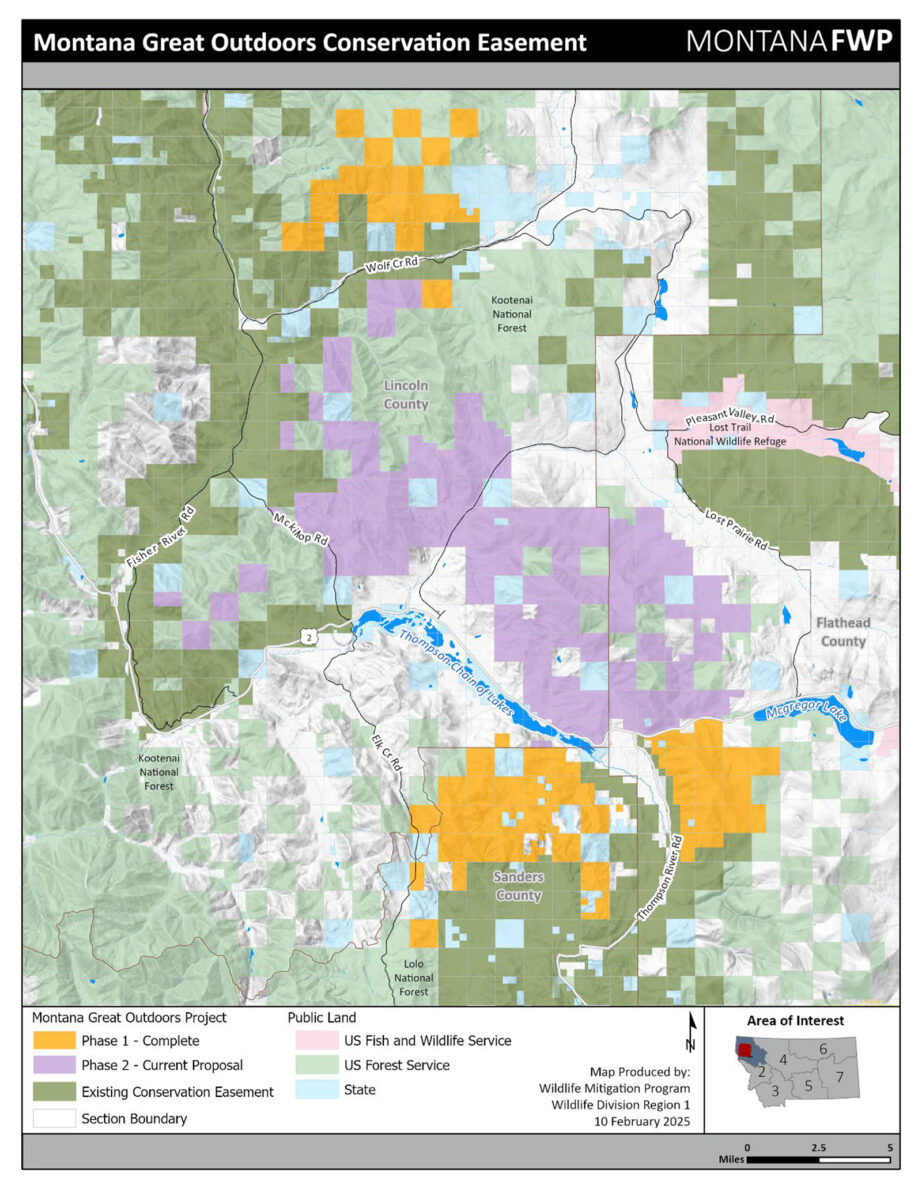
Montana Fish, Wildlife and Parks (FWP) is seeking public input on a proposal to put 53,000 acres of private timberland in Flathead and Lincoln counties under a conservation easement that would keep the land in production while protecting public access and wildlife habitat.
Last week, FWP published a draft environmental assessment that outlines the proposed second phase of the project, dubbed the Montana Great Outdoors Conservation Easement. In total, the project would encompass 85,752 acres of private timberland owned by Green Diamond Resource Company. The first phase of the project, which protected 32,981 acres in the Salish and Cabinet mountains, received final approval from the Montana Land Board in December. The new easement would encompass forestlands in the Cabinet Mountains between Kalispell and Libby.
Proponents of the Montana Great Outdoors Act’s first phase included timber interests, hunting and angling advocates, conservation groups, business leaders, and neighbors to the proposed land deal. The project is the culmination of a years-long effort by FWP, the nonprofit Trust for Public Land (TPL) and landowner Green Diamond Resource Company, which in 2021 purchased 291,000 acres of private timberland from Southern Pine Plantations (SPP), the real estate and investment company that in 2019 bought 630,000 acres from Weyerhaeuser Co., which acquired the land in 2016 from Plum Creek.
Despite the succession of private ownership, the land has been managed for de facto public access for more than a quarter century, in large part because the timber companies have been invested in long-term forest management as opposed to piecemeal development deals. But as demand for land intensifies in this corner of the state, so has a campaign to furnish permanent protections on northwest Montana’s working forests, which under a conservation easement can continue to produce lumber for local mills while allowing public access and preserving wildlife habitat, even as the state collects property taxes.
The property currently provides approximately 15,000 days per year of public hunting and angling use which would be secured in perpetuity under the easement, according to Jane Stoddard, bureau chief of the Montana Office of Tourism.
“This project has the potential to positively impact the tourism and recreation industry economy if properly maintained,” Stoddard wrote in a tourism report in support of the easement. “The opportunity to recreate in Montana is marketed to destination visitors from around the world. This includes emphasizing recreational opportunities in accessible locations.”
In 2021, Montana’s 12.5 million non-resident visitors spent over $5 billion in the state, according to a 2022 report from the University of Montana’s Institute for Tourism and Recreation Research (ITRR).
“The intent to visit has dramatically increased due to the pandemic and a desire for safe outdoor recreation experiences,” according to Stoddard. “Recreation access and activities are in high demand for both non-resident and resident visitors. Public access, vital to resident and non-resident visitors, could be limited or excluded if this project does not move forward.”
Jason Callahan, Green Diamond’s policy and communications manager, said the Seattle-based company’s support for the project, as well as a suite of other conservation easements either proposed or completed on its checkerboard of Montana timberland, is rooted in its tradition as a family-owned forest management company.
“This conservation easement is attractive to us because we retain full ownership of the land and full management discretion. It’s called a conservation easement but that’s just the name we’re given. We consider it a working forest easement,” Callahan said.
Despite setbacks to the timber industry, it remains a critical sector of the economy in Flathead and Lincoln counties, which produced 37% of Montana’s timber volume in 2022, with Flathead County producing 69 million board feet and Lincoln County producing 48 million board feet, according to the Bureau of Business and Economic Research (BBER) at the University of Montana. In 2018, sales from Montana’s forest products industry totaled $553 million and forest industry employment was 7,981 workers.
FWP is hosting a public informational meeting on March 5 from 5:30 p.m. to 6:30 p.m. at the agency’s regional office in Kalispell, located at 490 N. Meridian. The public is invited to attend and ask questions about the project.
“The private property provides abundant public hunting and angling opportunities that would be permanently secured under this proposal,” according to FWP’s request for comment. “This project would conserve wildlife winter range and a movement corridor for elk, mule deer, white-tailed deer, and moose. It would provide critical habitat for federally threatened species found on or near the property including bull trout, grizzly bear, Canada lynx, and wolverine as well as protect streams for westslope cutthroat trout and Columbia River redband trout, both Montana Species of Concern.”
If the project is approved, Green Diamond would maintain ownership of the land under an easement owned by FWP. The easement would allow Green Diamond to sustainably harvest wood products from these timberlands, preclude development, protect important wildlife habitat and associated key landscape connectivity, and provide permanent free public access to the easement lands.
The appraised value of the proposed second phase of the Montana Great Outdoors Conservation Easement is $57,544,144.20. Secured funding amounts and sources include: $1,500,000 from Habitat Montana, $200,000 from the Montana Fish and Wildlife Conservation Trust, and $35,805,000 from the U.S. Forest Service Forest Legacy Program. The Landowner, Green Diamond Resource Company, will provide $20,039,144.20 (which is approximately 35% of the value) of in-kind contribution in the form of donated land value arising from the sale of the easement.
Completion of this project would build on the success of the nearby 142,000-acre Thompson-Fisher Conservation Easement (FWP), the 100,000-acre U.S. Fish and Wildlife Service’s Lost Trail Conservation Area and other protected lands including the Kootenai and Lolo national forests, and the Thompson Chain of Lakes State Park.
The deadline to comment on the proposal is 5 p.m., March 15. To comment and learn more, visit https://fwp.mt.gov/news/public-notices.
FWP will review comments and forward a recommendation to the Montana Fish and Wildlife Commission on April 24, with a review and decision due by June 19. The Montana Land Board would then review the project and issue a decision on Aug. 18.