Fish and Wildlife Commission Approves Project to Conserve Timber Forests Near Libby
The easement on 53,000 acres of private timberland in Flathead and Lincoln counties would preserve public access and timber production. The project received unanimous commissioner support and now requires approval by the land board.
By Tristan Scott
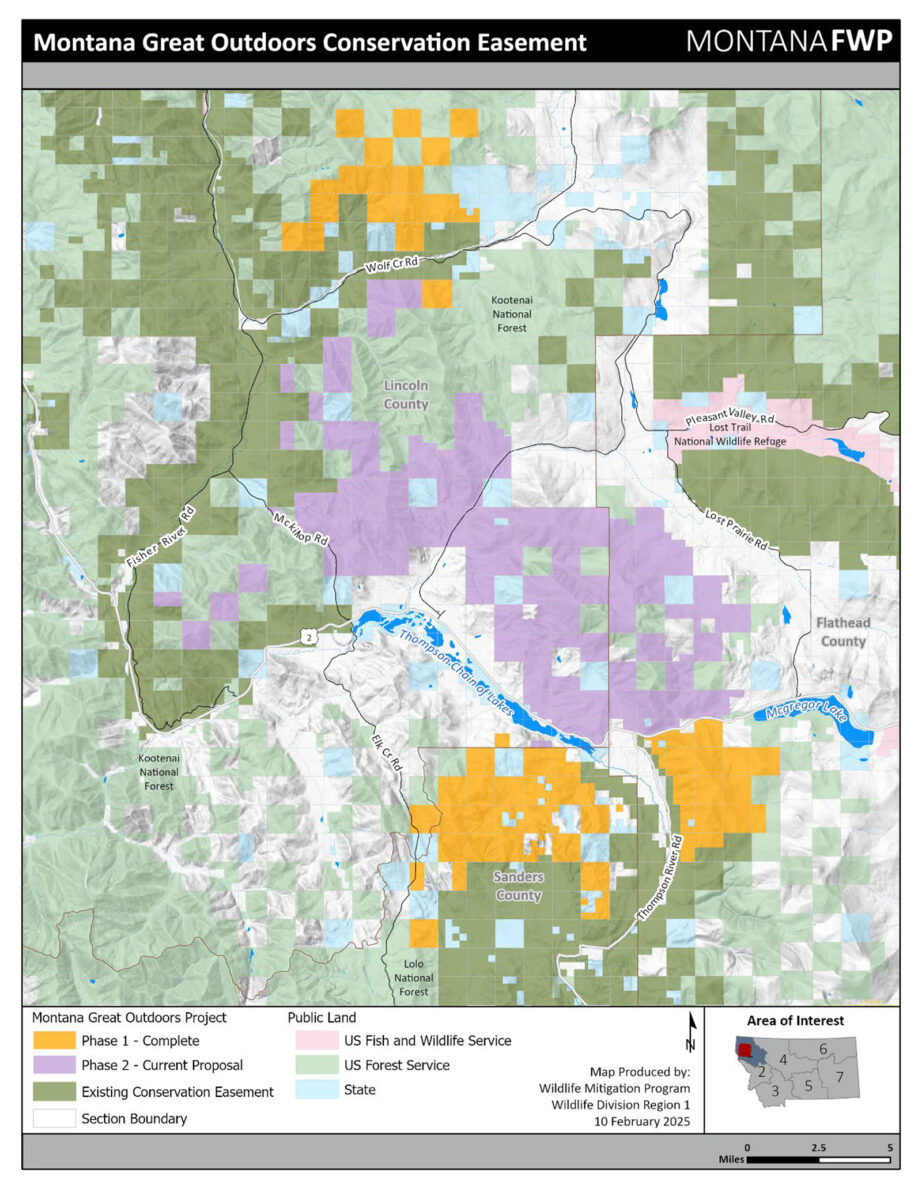
The Montana Fish and Wildlife Commission on Aug. 21 endorsed a project to permanently protect 53,000 acres of private timberland in Flathead and Lincoln counties, voting unanimously to support a conservation easement that would keep the forest in timber production while guaranteeing public access and preserving wildlife habitat.
Called the Montana Great Outdoors Conservation Easement, the project is now in its second phase. In total, the project would encompass 85,752 acres of private timberland owned by Green Diamond Resource Company. The first phase of the project, which protected 32,981 acres in the Salish and Cabinet mountains, received final approval from the Montana Land Board in December. The new easement would encompass forestlands in the Cabinet Mountains between Kalispell and Libby.
It must receive final approval from the Montana Land Board, which is scheduled to consider the proposal in October.
“As someone born and raised in the Flathead, I can’t show enough support for this project,” Ian Wargo, a member of the Fish and Wildlife Commission representing northwest Montana, said last week. “I was really excited to see all the county commissioners in Flathead and Lincoln counties submit letters of support for this project. I think it shows how fundamental it is to preserve recreation in northwest Montana.”
Proponents of the Montana Great Outdoors Act’s second phase included timber interests, hunting and angling advocates, conservation groups, business leaders, and neighbors to the proposed land deal. The project is the culmination of a years-long effort by the Montana Department of Fish, Wildlife and Parks (FWP), the nonprofit Trust for Public Land (TPL) and landowner Green Diamond Resource Company, which in 2021 purchased 291,000 acres of private timberland from Southern Pine Plantations (SPP), the real estate and investment company that in 2019 bought 630,000 acres from Weyerhaeuser Co., which acquired the land in 2016 from Plum Creek.
Despite the succession of private ownership, public access to the property is currently allowed through short-term block management agreements and voluntary open land policies, under which the land has been managed for de facto public access for more than a quarter century.
“For three generations the lands have been open to public use generously provided by these forestry companies,” FWP Land and Water Program Director Bill Schenk told the commissioners. “They have been treated as quasi-public land. Green Diamond has an open lands policy throughout its holdings, which is a very important component of access in Region 1.”
But as demand for land intensifies in the region, so has a campaign to furnish permanent protections on northwest Montana’s working forests, which under a conservation easement can continue to produce lumber for local mills while allowing public access and preserving wildlife habitat, even as the state collects property taxes.
Without a conservation easement in place, however, FWP warns that current or future landowners could terminate that access at any point.
According to Green Diamond’s Eric Schallon, it’s in the Seattle-based company’s best interests to remove the development interests on its land and allow the trees to regenerate, which is why it’s donating 35% of the land’s value to the state’s purchase of the conservation easement.
“I have been involved in this project since 2021 when we became the largest private landowner in the state of Montana,” Schallon told the commissioners. “We play what we call long game. We are stewards at heart and this property needs a chance to come back. It was hit pretty hard by prior owners so it’s in a regenerative state, and some of the forest management work we do for thinning and to promote fire resiliency for safety, that costs money. And projects like this is how we make things move.”
Despite setbacks to the timber industry, it remains a critical sector of the economy in Flathead and Lincoln counties, which produced 37% of Montana’s timber volume in 2022, with Flathead County producing 69 million board feet and Lincoln County producing 48 million board feet, according to the Bureau of Business and Economic Research (BBER) at the University of Montana. In 2018, sales from Montana’s forest products industry totaled $553 million and forest industry employment was 7,981 workers.
If the project is approved, Green Diamond would maintain ownership of the land under an easement owned by FWP. The easement would allow Green Diamond to sustainably harvest wood products from these timberlands, preclude development, protect important wildlife habitat and associated key landscape connectivity, and provide permanent free public access to the easement lands.
The appraised value of the proposed second phase of the Montana Great Outdoors Conservation Easement is $57,544,144.20 and includes $35,805,000 of federal funding from the U.S. Forest Service’s Forest Legacy Program. The Forest Legacy Program has two funding mechanisms: traditional Land and Water Conservation Funds (LWCF) and Inflation Reduction Act Funds (IRA). The grant for this project is funded by IRA.
The conservation easement would be perpetual, meaning it would remain in effect unless extinguished as a matter of law. The Forest Legacy Program, which awarded the $35.8 million grant, requires all conservation easements purchased with these funds to be perpetual.
Secured funding amounts and sources include: $1,500,000 from Habitat Montana, $200,000 from the Montana Fish and Wildlife Conservation Trust, and $35,805,000 from the U.S. Forest Service Forest Legacy Program. The Landowner, Green Diamond Resource Company, will provide $20,039,144.20 (which is approximately 35% of the value) of in-kind contribution in the form of donated land value arising from the sale of the easement.
Completion of the project would build on the success of the nearby 142,000-acre Thompson-Fisher Conservation Easement (FWP), the 100,000-acre U.S. Fish and Wildlife Service’s Lost Trail Conservation Area and other protected lands including the Kootenai and Lolo national forests, and the Thompson Chain of Lakes State Park.
David Weinstein, TPL’s Northern Rockies director, said the Montana Great Outdoors Conservation Easement is a prime example of his organization’s mission to “safeguard against the conversion of lands out of a strong traditional economy of timber” while also “ensuring every acre of this land will be publicly accessible.”
“The completion of phase 1 last fall, which constituted more than 30,000 acres of land, was critical to prevent the very real threat of land conversion and subdivision and development,” Weinstein told the commissioners last week. “Phase 2 doubles down and improves recreational access for hiking, hunting, fishing and more. It will also continue to ensure sustainable timber management and stitches together over a quarter of a million acres of Forest Legacy projects completed over the last 20 years in Montana.”
According to Weinstein, every dollar invested by the state leverages $38 in costs contributed by the landowners, the federal government and TPL.