Republican Property Tax Split Presses on, Months After the Party Divided Votes on Tax Reform at the Legislative Session
Senate President Matt Regier claims a $126.2 million supplemental for schools was indicative of a “sloppy” legislative process — a suggestion that has drawn pushback from other legislators and education advocates
By Mariah Thomas
When the state legislature met at the beginning of 2025, one issue was top of mind.
“The most important issue for Montanans as we started that session was providing property tax relief,” said Rep. David Bedey, R-Hamilton. “It wasn’t social issues, it wasn’t anything else, it was property tax relief.”
Bedey, along with a slew of other legislators and stakeholders, had participated in a property tax task force convened by the governor to come up with solutions a year before the session happened. Residential property values have soared in Montana since the COVID pandemic — and along with it, residential property taxes have climbed.
But throughout the session, legislators didn’t see eye-to-eye on what measures would offer meaningful tax relief to Montanans. Some pushed for Senate Bill 90, a measure that would have redirected some state bed tax revenue to property tax rebates. More recently, the state’s Chamber of Commerce has begun calling for conversation about implementing a statewide sales tax. Montana is one of only a handful of states that doesn’t have one in place. Eventually, in the session’s waning days, a coalition of Democrats and Republicans passed House Bill 231 and Senate Bill 542. The pair of bills rewrote tax rates and will implement a homestead exemption starting next year.
Debate over the bills has endured well after the legislature passed them, with lawmakers duking it out over their consequences in newspaper opinion pages across the state. Some herald the achievements of HB 231 and SB 542; others have raised issues and concerns with the laws.
It’s a battle of rhetoric, taking place among a Republican Party trying to determine how it wants to govern as it’s gained political power in a historically purple state. That debate became a major storyline during the 2025 legislative session. Some Republicans crossed party lines and sided with Democrats to pass Medicaid expansion, property tax relief, and reject a slew of bills aimed at making Montana’s court races partisan. It earned some of those who crossed the aisle ire from fellow Republican Party members.
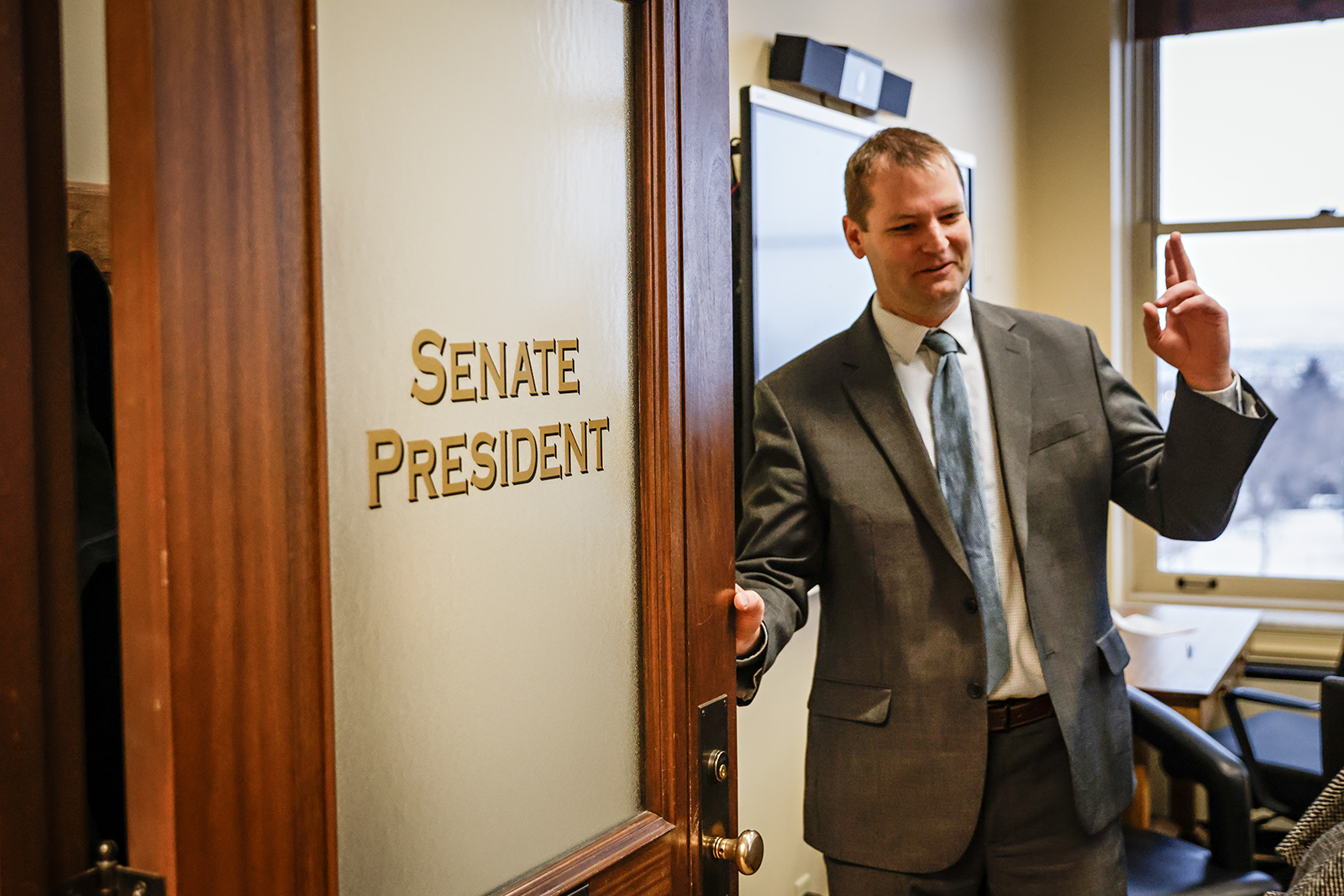
Now, the ongoing rhetorical battle over property taxes has entered a new chapter, as Senate President Matt Regier, R-Kalispell, calls attention to a larger-than-usual dollar amount the state will have to fill for school funding.
Over the next two years, roughly $126.2 million is projected to flow from Montana’s general fund toward education, filling in the Base Amount for School Equity (BASE) that schools rely on to operate.
The $126.2 million is much higher than the typical amount. Usually, around $15 million to $30 million from the state’s coffers helps backfill education depending on fluid school enrollment figures that play a large role in determining school funding in the state, according to Lance Melton, the long-term executive director of the Montana School Boards Association. The $126.2 million amount may not be exact. In recent years, falling school enrollment means school funding has come in under budget. But it’s uncertain, because Montana’s school funding relies heavily on the number of students in classrooms, which changes year-to-year.
Regier claims the higher dollar amount this year is indicative of a “sloppy” legislative process.
“I’m not going to say the sky is falling,” Regier said. “My point as a legislator is like, this is a horrible way to be doing budgeting and appropriations. That big of a mistake is embarrassing.”
Other legislators and education advocates bristled at the suggestion the $126.2 million, known as a “supplemental,” was a mistake. Rep. Llew Jones, R-Conrad, the architect and sponsor of HB 231, said the figure appeared on every fiscal note about the bill.
“To pretend it was unknown is bull,” Jones said. “It was known.”
Melton, with the Montana School Boards Association, seconded Jones. He said the supplemental was a known factor. Melton added that funding for schools is constitutionally required, so the state must fill it.
As it stands, school funding in Montana can be likened to a two-legged stool. The first leg: state trust land funding. The Department of Natural Resources and Conservation and Office of Public Instruction announced Dec. 15 that $80.8 million will flow to schools from trust lands this year. And the second leg comes from the 95 mills, a figure that fluctuates depending on taxable value of residential property. Then, whatever those two funding sources don’t fill, the state provides.
The reason the state’s input increased this year is because, with the tax code rewrite, taxable values fell this year. In turn, it required the state to put more funding into the pot to make it up. Melton said education advocates have long called for the state to put more into education, and the change should make local property taxpayers “elated.” In the future, the large number to be filled as a supplemental will shrink, with the figure reflected in the state’s budget.
But legislators disagree on several aspects of the $126.2 million supplemental, from its significance and impact on the state’s schools, to where the blame lies for its existence. Their disagreements reveal remaining rifts from the legislative session.
Regier, the Senate president, said having a supplemental that high puts schools in a precarious position. If things remain status quo, he said the money should be backfilled. But should a depression or recession hit, for instance, Regier said an adequately-funded school system would have to be funded in that environment — which could mean less money to go around.
“There’s always a question mark every session that we come in of: what is the legislature going to fund?” Regier said. “If you’re coming in as any program, what does the economic landscape look like?”
And, he argues, no matter what, asking for more funding than a program was budgeted for is a challenging position to be in.
Bedey, a Hamilton Republican who has long been a leading voice in legislative conversations on education, said the idea that the supplemental or the property tax bills passed by the legislature will adversely affect school funding is untrue.
“I’m concerned that the people who are making those sorts of assertions … either misunderstand school funding or they are grasping at straws in order to attack the property tax bills passed by the legislature and signed by the governor,” Bedey said.
Even though legislators went into the 2025 session with a mandate to act on property taxes, one of the bills tackling the issue stalled early.
House Bill 231 passed its readings in the House on Feb. 27. But the Senate Taxation committee tabled it April 2, where it then went through a wonky process of stalls and starts until it was finally adopted April 30 — the session’s last day.
Senate Bill 542, HB 231 and House Bill 2, the state budget, all passed on the session’s last day, leaving no time to incorporate the property tax bills’ impacts into the state budget. HB 2 is typically one of the final bills to make it through the legislative process. But legislators involved in property tax relief efforts had hoped those bills would pass earlier.
“In a perfect world, if we had gotten to these bills earlier so they weren’t being crunched together, there would’ve been a more deliberate way to make these appropriations,” Bedey said.
Regier said the last-minute nature of the property tax relief bills meant “those property tax bills were changed, and deals were being made” in the session’s last days.
“Things were going fast,” Regier said.
Bedey and Jones both said the reason the bills’ timeline was squeezed at the session’s end was because of Regier’s Senate. More specifically, they placed blame with Sen. Carl Glimm, R-Kila, who chaired the Senate Finance and Claims committee. SB 542 passed through that committee. Bedey and Jones both lobbed accusations that Glimm refused to call meetings of his committee in the session’s waning days. Per the committee’s calendar, the last meeting of the Senate Finance and Claims committee happened April 18 — 12 days before the session’s wrap-up on April 30.
“We were just wasting our time in committee because they were blasting out bills before they even had a hearing,” Glimm said.
“Blasting” a bill refers to a process when a majority of the Senate can vote to revive legislation that has been tabled. The practice took place several times in the conflict-ridden Senate during the session. A coalition of nine moderate Republicans and the 18-member Democratic minority teamed up to bring several bills to the floor.
The property tax bills that passed, HB 231 and SB 542, went through a tumultuous legislative process, only gaining the momentum to pass at the session’s tail end. Each passed the Senate by a margin of 28-22 votes, with eleven Republicans crossing over to vote with 17 Democrats.
“It was a rushed process and unfortunately — it’s a term I used over and over again in the session — but the cake was baked,” Glimm said. “They knew they had the votes they needed to pass what they wanted to pass, and that’s what it came down to.”
After HB 231 and SB 542 took partial effect this year, 80% of Montana’s residential property owners saw tax reductions. Another 10% saw property taxes remain flat. On average, homeowners who saw tax cuts received a reduction upwards of $500 — not including an additional $400 rebate that went to eligible property owners.
That doesn’t mean everyone has felt relief. Some commercial properties’ tax bills are way up compared to relatively flat bills they’ve paid in previous years. Those in the Flathead whose homes are valued upwards of $1.25 million, on average, saw increases to their taxes, per Department of Revenue data. In October, Lee Enterprises’ State News Bureau reported on a mistake in the bills. That mistake unintentionally raised the tax rate on multifamily units, like apartment buildings. The reporting found the cost will likely be passed on to taxpayers in the form of raised rent — an unintended consequence from the bills.
It’s that type of error, combined with items like a higher-than-normal supplemental, that calls the legislative process into question for Regier and Glimm.
“The question is not what is the right process, but what’s the best process?” Regier said. “And I would say when we were making mistakes like this, it’s not the best process.”
“To have an error in that amount on school funding is crazy,” Glimm said. “It just goes to show how the process was manipulated.”
Bedey admits having a glitch in the legislation — the multifamily unit error — may detract from the good it does. But he’s clear the supplemental for school funding wasn’t a mistake.
For him, the more burning question is what opponents of the legislation would suggest doing instead to provide meaningful property tax relief.
Glimm did carry an alternative bill in 2025 to combat property tax hikes in Senate Bill 90. That piece of legislation, in its final form, would have redirected state revenue from lodging taxes and rental car taxes to primary residence property tax relief, in the form of offering rebates to taxpayers to offset tax hikes.
Regier threw his support behind SB 90. It was initially estimated to give each primary residence owner in the state $437 in property tax assistance in 2026. Glimm said that relief would’ve been applied directly to property taxpayers’ bills as a credit from the state. Several other Republicans favored the legislation too. Regier’s support for it hinged on the idea that property tax relief shouldn’t come at the cost of bumping up tax rates for other types of properties, like commercial property or second homes. The bill proposed cutting numerous tourism-related programs, drawing criticism from small business owners, state officials and industry representatives, who cautioned the cuts would heavily impact the state’s tourism industry.
The $437 figure that would’ve been provided to relieve taxpayers was whittled down, Glimm said, as stakeholders critiqued the legislation and amendments were made. By the end, the relief it would offer was far less. SB 90 passed its three readings in the Senate, but died in the House in April. Jones, who carried HB 231, said SB 90 was a “joke.” Bedey said, when compared to the more substantive relief HB 231 and SB 542 provided, it felt obvious those bills were a better answer for Montanans.
Still, Glimm remains adamant that the answer to the property tax conundrum lies with using other funding sources to pay for the items property taxes cover — primarily local government services and public schools.
“At the state government, we’ve been flush with cash for the past three or four sessions,” Glimm said. “What we need to do is share the wealth of the state. The state keeps growing our budget, and we keep spending more money, and it’s hurting citizens because they can’t afford their property taxes.”
In Bedey’s eyes, the government is tasked with certain responsibilities. Among them: providing income for employees at state agencies, funding schools and more. While he said he agrees with the Republican Party’s general stance that smaller government is better government, he also thinks to achieve that goal, legislators must understand what they’re proposing to cut.
“Any serious conversation about cutting property taxes or taking control of them, there’s always the question of: what are we willing to give up if the revenue’s not there?” Bedey said.
That question isn’t easy to answer. And holding onto ideological stances without a willingness to compromise or have difficult conversations doesn’t help, he said.
Perhaps the one aspect of the property tax debate legislators from all factions of the Republican Party agree on: it’s not a finished conversation. Regier, Glimm, Jones and Bedey all said they felt that was true.
“I think there’s always going to be opportunities to rework our property tax system to make sure it’s fair to all the various properties we have,” Bedey said.