Under New Cleanup Plan, Town Pump ‘Actively Working’ to Reduce Contaminant Concentrations on Whitefish River
According to state regulators, recent sampling results of the petroleum seeps first detected decades ago no longer exceed water quality standards for human health
By Tristan Scott
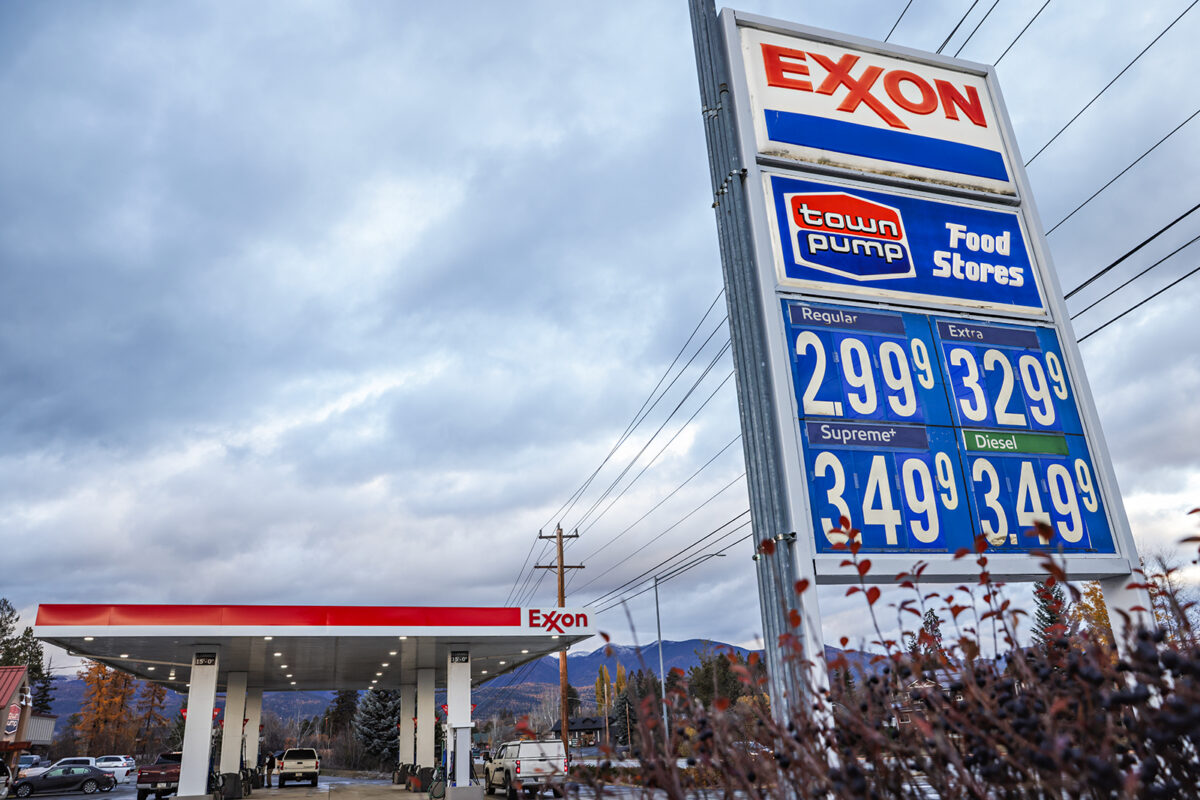
A new state-approved cleanup plan is underway to resolve a decades-old petroleum seep at a Town Pump gas station located 200 feet from the Whitefish River, where contaminants such as benzene have for years leached into the surface water and groundwater at concentrations exceeding human health standards.
First detected in 1989, the source of the contamination is at the center of an open and ongoing remedial investigation, which local stakeholders say has dragged on far too long.
And while officials with the Montana Department of Environmental Quality (DEQ) acknowledge that a range of remediation strategies have had ” varying degrees of effectiveness” through the years, new evidence suggests the contaminant concentrations are decreasing.
In October, DEQ approved a new “remedial investigation work plan” at the Town Pump, with initial groundwater sampling occurring in November. According to DEQ’s Petroleum Tank Cleanup Section Supervisor Latysha Pankratz, those samples were collected from eight monitoring points located nearest the Whitefish River. All the sample tests showed contaminants, including benzene, at below risk-based screening levels and human health standards, Pankratz said.
“There were low-level detections but nothing exceeded standards,” Pankratz said.
Other monitoring wells located near the gas station were not included in the latest round of sampling; however, those monitoring wells will be sampled in the future and the results made public, Pankratz said, along with continued sampling of the eight locations near the Whitefish River.
“The main focus has been on preventing contaminants from reaching the Whitefish River, which is what we would consider to be an immediate receptor that we want to protect,” Pankratz said of past cleanup strategies, adding that pilot testing of new remediation technology is set to begin soon. “Town Pump, with oversight from DEQ, has been very responsive. They have been actively working with their environmental consultant and with DEQ to identify effective remedial strategies, and they continue to do so. The 2025 water sampling results confirm this.”
Even so, the drawn-out timeline to resolve the petroleum seep — or “release” — has vexed a growing succession of local government officials dating back to the mid-2000s, when the head of the Whitefish Lake Institute, Mike Koopal, began raising concerns about the petroleum seep to city council. Although Koopal welcomed the agency’s renewed attention to a pollution problem that’s been brewing for decades, he said the Whitefish Lake Institute would conduct its own independent testing in 2026.
“My concern remains that this issue represents the proverbial kick-the-can-down-the-road situation as evidenced by the protracted timeline of mitigation attempts,” Koopal told the Beacon in November after growing frustrated by the lack of progress. “The current situation of contaminant release to groundwater and the Whitefish River does not meet WLI’s vision for water quality and community health.”
Whitefish city officials have been asking DEQ to prioritize the cleanup for nearly 20 years, including in an August 2007 letter to former agency director Richard Opper, who in his response downplayed the significance of the contamination, writing that it was “not viewed as a major public health or environmental threat” while assuring elected officials that “this work is progressing at an acceptable rate.”
Last July, Pankratz provided city officials with a facility cleanup chronology and assured current Mayor John Muhlfeld that he would “be included in future correspondences for the facility and associated releases.”
Today, petroleum hydrocarbons, such as gasoline, remain present in the groundwater over an area of about 70,000 square feet on the Town Pump property, with the worst concentrations detected near the facility’s historic and existing underground storage tank basins, as well as the fuel dispenser area.
The history of the pollution dates back to 1989, when Town Pump purchased the former Roundup Country Store on Spokane Avenue and discovered petroleum contaminated soil while making upgrades to the service station’s historic underground storage tank basin. Under DEQ oversight, the contaminated soil was removed from the tank basin and the fuel dispenser area, but it was left in place along the floor of the excavation area and along its perimeter walls.
Because federal standards for petroleum concentrations in groundwater had not yet been developed at the time, DEQ closed its investigation into the release “based on the information available at the time.” In January 2003, a 0.1-gallon-per-hour gasoline leak from a fuel line in the dispenser area prompted DEQ to open an investigation into a second petroleum release at the site. In 2016, an environmental services firm working on Town Pump’s behalf determined the two releases had “comingled” and were causing site-wide contamination, recommending DEQ reopen its investigation into the initial 1989 release. The agency did so in 2017.
Although there are no active fuel line leaks occurring on the property, the petroleum-saturated soil continues to release contaminants into the surface water and groundwater near the Whitefish River.
In recent years, monitoring and sampling has continued while “cleanup strategies such as air sparge, soil vapor extraction, hydrogen peroxide injection, and nutrient injection have been used to control and cleanup the petroleum contamination,” according to an “Additional Remedial Investigation Work Plan” prepared in July 2025 by a Missoula-based environmental services company, West Central Environmental Consultants, Inc. (WCEC).
That plan describes a range of remediation strategies used to break down contaminants at the site since 2011, including hydrogen peroxide injection wells designed to accelerate the biodegradation of petroleum hydrocarbons. The hydrogen peroxide injection system became operational in April 2011; by the end of 2016, approximately 7,285 pounds of oxygen had been injected into the aquifers, resulting in the degradation of 400 gallons of gasoline.
However, remediation efforts have been hampered by the enduring presence of petroleum concentrations that won’t dissolve, according to WCEC’s investigation report, as well as the “limited area of influence of the existing injection wells.”
At DEQ’s request, the hydrogen peroxide injection and soil vapor extraction systems were shut down in 2017 in order to reassess the scope of the contamination using a laser-induced fluorescence technology, which Pankratz said allowed the agency to “monitor real time data and gain a better understanding of the site’s characteristics — its complex geology and hydrogeology.”
“With that, we were able to determine that the previous release still had contamination contributing to the overall situation, so that was reopened,” Pankratz said.
Meanwhile, groundwater samples collected in October 2018 revealed that benzene concentrations remained high in multiple monitoring wells, with the highest benzene concentration registering at 5,380 micrograms per liter. The U.S. Environmental Protection Agency classifies benzene as a known human carcinogen and established a maximum contaminant level of 5 micrograms per liter for public drinking water.
Based on that investigation, DEQ hired a consultant to review data and develop a conceptual site model, known as a Remedial Alternatives Assessment, “and really try to get our heads around this.”
“This has been going on for a long time, and we wanted to know whether there are data points missing, and what specifically is slowing and inhibiting the cleanup,” Pankratz said. “Town Pump has submitted and we have approved this work plan, they took soil samples and groundwater samples of the seep that were below standards, including benzene, so that is good news.”
According to findings from WCEC, the environmental services firm that completed the most recent work plan, Town Pump will continue the air sparging system “until petroleum hydrocarbon concentrations in groundwater at the seep are below” risk based screening levels and human health standards.
The DEQ has also approved a pilot-scale high vacuum dual phase extraction (HVDPE) remediation study, which requires the installation of two new extraction wells immediately north of the facility “in a manner that targets impacts to the deeper, regional aquifer,” according to the work plan.
The cost of the initial site inspection and monitoring by West Central Environmental Consultants, Inc., is $40,146.80. That figure does not include costs to complete the pilot study or remaining scope of the remediation work.
Pankratz said roughly half of the costs are covered by the state Petroleum Tank Release Compensation Board and Town Pump, which paid $20,724.20, with Town Pump responsible for the rest.
The Petroleum Tank Release Compensation Board is attached to DEQ for administrative functions, such as fiscal and human resources, but is otherwise considered an independent entity, according to an agency spokesperson.