USDA Moves to Repeal ‘Failed’ Roadless Rule, Stripping Protections Across 44 Million Acres of National Forest
The initiative drew immediate backlash from public land advocates and triggered a 30-day public comment period. It's the last chance for the public to weigh in before the rule could be rescinded.
By Tristan Scott
The U.S. Forest Service on Tuesday submitted its plan to fully repeal the 2001 Roadless Area Conservation Rule, undoing a 25-year-old federal protection covering 44 million acres of national forest in favor of delegating decision-making authority to local land managers.
The move comes more than a year after Agriculture Secretary Brooke Rollins announced the administration was taking initial steps to rescind the “one-size-fits-all” policy, generating intense backlash from conservation groups and public land advocates. Although the administration and industry stakeholders frame the rescission as a return to forest-level land management planning that leaves other environmental guardrails intact, conservation groups say it opens critical wildlife habitat to logging and fragmentation with few practical constraints once the national designation is gone.
Moreover, critics say the consequences of the repeal are compounded because it occurs amid a host of other initiatives the Trump administration has pursued to weaken environmental protections, from undermining the Endangered Species Act to subverting state climate rules.
“When overwhelming majorities from across the political spectrum support current prohibitions on building new roads, it’s clear Washington isn’t listening,” Barb Cestero, Montana state director for The Wilderness Society, said in a prepared statement. “Montanans want to see these forests conserved for the clean water, habitat, and access to nature they provide.”
According to Rollins and supporters of the repeal, however, the Roadless Rule is out of step with the modern era of forest management challenges. Specifically, it has frustrated land managers and served as a barrier to managing and mitigating wildfire risk, inhibiting forest managers from thinning overgrown and diseased stands across large swaths of the National Forest System, including in Montana.
“For 25 years, the heavy thumb of Washington D.C. has hindered Montana’s ability to properly manage wildfire risk and road development on nearly 60 percent of Forest Service land across the Treasure State,” Montana Gov. Greg Gianforte said in a prepared statement Tuesday. “Today’s long overdue decision will empower states like Montana to pursue proper forest management on federal lands with local communities in mind.”
Utah Gov. Spencer Cox and Wyoming Gov. Mark Gordon issued similar statements framing the change as a return of authority to state and local land managers.
WHAT DO THESE CHANGES MEAN FOR NORTHWEST MONTANA?
We’re committed to highlighting our great outdoors and the policies and conversations shaping it. And you can help! Become a member to support more reporting on public lands and keep you and your neighbors in the loop and on the trails.
Established under the Clinton administration and enacted in 2001, the Roadless Rule generally prohibits road building and logging across 58.5 million acres of national forest roadless areas nationwide. Over time, Idaho and Colorado opted into their own state-specific roadless regulations that supersede the rule, leaving roughly 44 million to 45 million acres — spread mainly across 10 Western states — governed by the national rule today, the acreage targeted by the current rescission proposal.
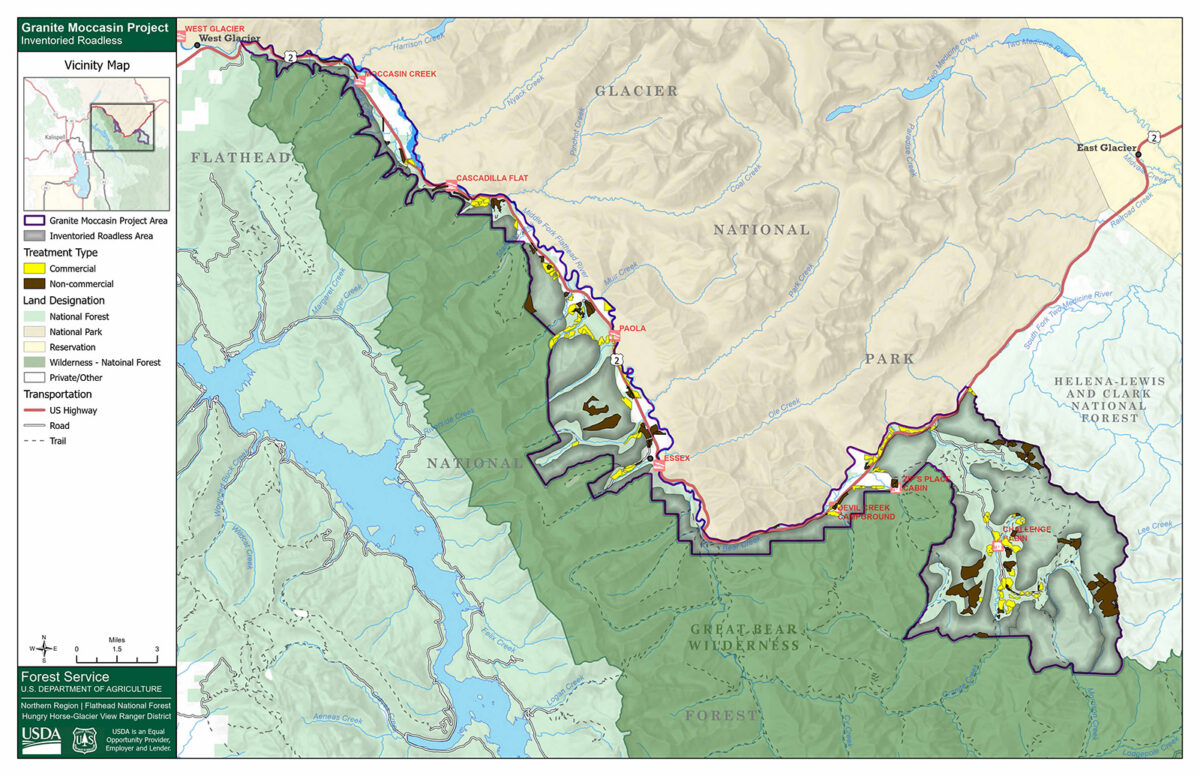
The rule has never been an absolute bar on management activity. It makes exceptions for accessing non-federal land inholdings and pre-existing mineral leases, and it allows logging, vegetative treatment and prescribed burning to reduce fire risk, improve wildlife habitat, or aid recovery of at-risk species such as whitebark pine. On the Flathead National Forest, for example, the recently approved West Reservoir Project near Hungry Horse Reservoir includes more than 4,600 acres of prescribed burning within areas protected under the rule, while the Granite Moccasin Project along the Wild and Scenic-designated Middle Fork Flathead River authorizes 2,250 acres of forest management in Inventoried Roadless Areas with the objective of reducing the risk of wildfire near communities.
When the rule was adopted 25 years ago, its primary aim was reining in the scale of a Forest Service road-building campaign that had grown unwieldy. The agency still maintains roughly eight times more miles of road than the Interstate Highway System, and at the time the rule was adopted, its road maintenance and reconstruction backlog had grown to $8.4 billion. Despite the skyrocketing costs, it received only about 20% of the annual funding needed to bring the existing system up to current environmental and safety standards.
Under Tuesday’s proposal, along with a draft environmental impact statement filed the same day, the rule’s national designation would be eliminated and roadless-area decisions would shift to individual national forest management plans, shaped by local conditions and input from states, tribes and communities.
Forest Service Chief Tom Schultz said more than 40% of inventoried roadless areas, concentrated in the West, carry high or very high wildfire hazard potential, but only 5% of those acres have received hazardous fuels treatment since 2014; he noted that 11.3 million roadless acres already sit near existing roads.
The move drew swift condemnation from national and local conservation organizations, which characterized it as a rollback of one of the Forest Service’s most significant conservation measures rather than a wildfire fix.
Proponents of the Roadless Rule dispute the administration’s wildfire rationale, citing Forest Service data that roughly nine in 10 wildfires are human-caused, along with newer research finding that fires are about four times more likely to start near roads than in roadless areas. According to that research, more roads mean more ignition sources, including discarded cigarettes, campfires and vehicle undercarriages, not less fire risk, especially at a time of reduced federal firefighting capacity.
Groups including the Natural Resources Defense Council, The Wilderness Society, Defenders of Wildlife, the Sierra Club, Environment America and the Women’s Earth and Climate Action Network disputed the administration’s wildfire justification directly. They also cited evidence that a majority of public feedback opposed repealing the Roadless Rule.
Meanwhile, timber industry stakeholders, including the American Forest Resource Council (AFRC), applauded the proposed repeal of a “failed policy,” saying in a statement that it would give professional land managers “greater flexibility to address wildfire risk and declining forest health on millions of acres of National Forest System lands.”
“The Forest Service is right to take a hard look at a policy that was written for forest conditions that looked very different 25 years ago,” AFRC President Travis Joseph said. “We should continue to adapt and learn from failed policies to meet the moment, not continue to cling to positions and ideas that don’t serve the public’s interest.”

The rule change would apply to national forests in 10 Western states — Alaska, Arizona, California, Montana, Nevada, New Mexico, Oregon, Utah, Washington and Wyoming — which together hold more than 95% of inventoried roadless acreage. Some of the largest holdings are in Alaska’s Tongass National Forest, the world’s largest temperate rainforest, which advocacy groups say is at particular risk from increased logging and mining if protections lapse.

Rescinding the Roadless Rule has been a top administration priority since the USDA first announced its intent in 2025, on the grounds that the rule impedes “responsible forest management” and wildfire mitigation. Apart from the administrative rulemaking process, Sen. Mike Lee, R-Utah, moved to repeal the rule legislatively, introducing an amendment to S. 140 on June 9 that would bypass the rulemaking process entirely. The Senate Energy and Natural Resources Committee, which Lee chairs, voted 11-9 along party lines — with members including Sen. Steve Daines, R-Mont. — to advance the amended bill to the full chamber, where it faces a high hurdle requiring 60 votes.
The move drew sharp rebukes from Democrats on the committee, several of whom characterized it as derailing what had been a bipartisan push on forest management and wildfire prevention.
“I have to go on record with disappointment on how Republicans are pushing this poison pill on what was otherwise a bipartisan opportunity,” said Sen. Maria Cantwell, D-Wash., who directed her criticism at Lee, the committee chairman.
“I definitely am perplexed by this morning’s markup and hearing,” Cantwell said at the June hearing. “I think we may be creating an artificial divide. I mean, it’s clear, Mr. Chairman, that you would like to sell public land. But on our side of the aisle, we would like to come together to acquire public land and set it aside for the general public to use. There’s a divide here and it’s a bad divide. Let’s be efficient with taxpayer dollars. Let’s not kill the Roadless Area Rule; let’s make sure that we are working together on fire prevention and make smart use of public policy because it’s a damn big [outdoor recreation] economy and doing anything else is just wrongheaded.”
Sen. Alex Padilla, D-Calif., said the amendment undercut a rule that had itself been the product of extensive public input.
“The last-minute move destroys any bipartisan opportunity for compromise on this,” Padilla said. “And let me remind you that the 2001 Roadless Rule was created through one of the most extensive public rulemaking processes in history, garnering over 1.6 million public comments with 95% of them in support. The rule remains incredibly popular across the country with more than half a million public comments in opposition to this administration’s recent efforts to repeal the rule. We now see the Republican majority on this committee working feverishly against the will of all of our constituents.”
Sen. Martin Heinrich, D-N.M., credited Sen. John Barrasso for crafting a bipartisan measure aimed at reforming forest management to reduce wildfire risk, but said repealing the Roadless Rule undermined it: “I think putting the repeal of the Roadless Rule into this just blows that up.”
Since Rollins’ 2025 announcement, more than 625,000 public comments have been filed opposing the rollback, and former Forest Service chiefs have spoken out against it; conservation groups say the agency has not held a public hearing on the proposal, prompting independently organized “people’s hearings” around the country.
The Forest Service is accepting public comment on the proposed rule and the draft environmental impact statement through Regulations.gov. USDA’s announcement set a deadline of midnight Sept. 21; conservation groups described the comment period as 30 days from the filing of the draft environmental impact statement. Additional information was expected to be posted to the Forest Service’s Roadless Areas website on Aug. 19. It marks the final opportunity for public input before the agency can finalize the rescission.