Describing a memorandum of agreement (MOA) with Glacier National Park as an “historic moment rooted in sovereignty, healing and shared responsibility,” leaders of the Blackfeet Community College (BFCC) on Jan. 22 reached an accord with their National Park Service (NPS) partners to “foster mutual educational, cultural and professional benefits.”
“This MOA is the start of an intentional, collaborative relationship between BFCC and GNP to foster mutual educational, cultural, and professional benefits to partners,” according to a statement announcing the MOA, which coincided with BFCC’s annual Bear River Commemoration.
BFCC hosted the two-day event Jan. 21-22 to observe the 156th anniversary of the Bear River Massacre, also known as the Baker Massacre or the Marias Massacre of 1870, during which an estimated 200 Piegan (Blackfeet) Indians were killed while camped along the Marias River in what one company commander described as “the greatest slaughter of Indians ever made by U.S. troops.”
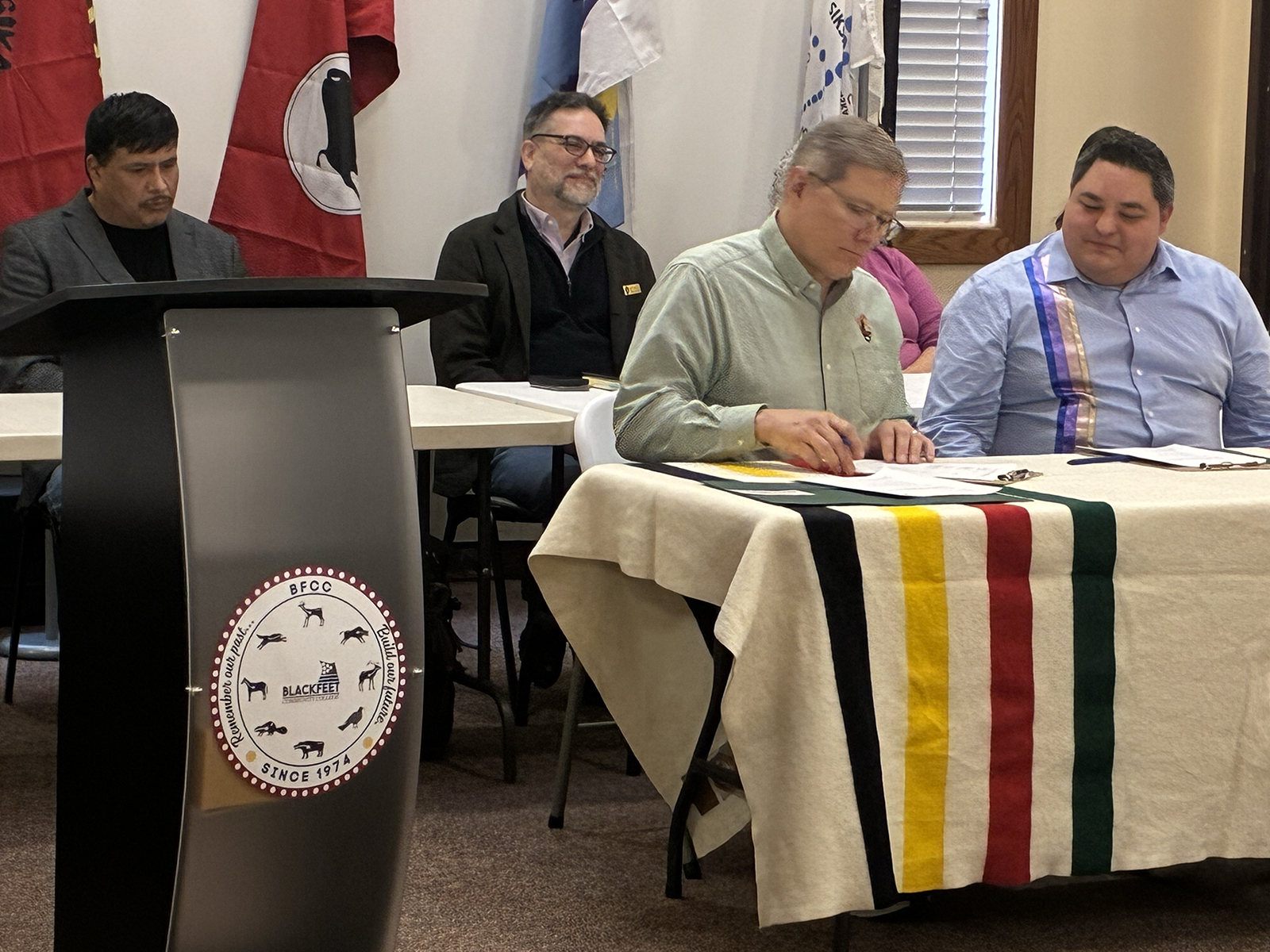
Organized to educate the public about the massacre, last month’s Bear River Commemoration included a ceremonial signing of the MOA and presentations about the newly minted partnership by BFCC President Brad Hall, Glacier Park Superintendent Dave Roemer and Regional NPS Director Brian Carlstrom (see below for a photo of the signing ceremony).
“The college is a key resource for community-based knowledge,” Hall said. “This partnership will be an important step in providing homeland access for community healing, advancing the park as a source of traditional ecological knowledge, and furthering partnerships to advance student success and community engagement initiatives at the college.”
“It’s an honor to be a part of strengthening connections between the college and the park and supporting Blackfeet culture and learning in Glacier National Park,” Roemer added. “This agreement furthers the Department of Interior’s goal of supporting tribal sovereignty and traditions.”
But less than a week later, the Washington Post identified Glacier as among 17 national parks in which Trump officials have instructed staff to remove signs and interpretive displays “related to climate change, environmental protection and settlers’ mistreatment of Native Americans,” according to the Post.
“Blackfeet people no longer have control of our own story,” the Blackfeet Tribal Business Council posted in a statement to social media last week. “As of January 2026, the Trump administration has directed the [NPS] to remove or revise signs, exhibits, and educational materials across numerous U.S. national parks that address the mistreatment of Native Americans, climate change, and other contested historical realities.”
I’m Tristan Scott, here to deliver the rest of your Daily Roundup on the first Monday of the month.
According to the Post, parks affected by the order include Glacier National Park and the Little Bighorn Battlefield National Monument. Blackfeet tribal leaders say that, at Glacier, materials documenting the U.S. Army’s 1870 massacre “have been specifically targeted for removal.”
“That includes both a brochure and a physical sign that acknowledged this history,” according to the tribal council.
Under President Trump’s Department of the Interior, NPS is tasked with implementing the executive order, titled “Restoring Truth and Sanity to American History,” which requires federal agencies to review public-facing materials to ensure alignment with “shared national values.” Interior officials have confirmed that signage across the entire national park system is under review.
Civil rights, Indigenous, and environmental organizations warn that the actions threaten to undo decades of progress toward acknowledgment of historical injustices. In Glacier National Park — the crucible of the Blackfeet creation story, where climate change is visibly reshaping glaciers and ecosystems — “the removal of this information risks erasing essential context about the park’s past, present, and future,” according to the tribal council’s statement.
If the recent MOA between BFCC and Glacier represents an historic accord, it belies tensions over a boundary line dispute that has simmered for more than a century.
Although the Blackfeet Nation shares its western boundary with Glacier National Park, tribal leaders have long asserted that the boundary, which is part of what’s known as the “ceded strip,” was established in 1896 without proper consultation or compensation. Last year, the Blackfeet Tribal Business Council approved a resolution to explore its legal right to “pursue a claim on behalf of the Tribe to reestablish the western boundary line of the Blackfeet Reservation … and to pursue acquisition or restoration of lands consistent with that boundary.”
At the time, Superintendent Roemer acknowledged the significance of the ceded strip to the Blackfeet Nation and pledged to continue engaging with tribal leaders on discussions over the boundary line.
“The ceded strip and questions concerning the boundaries of the Reservation are understandably important to the Blackfeet Nation,” Roemer said in a statement to the Beacon. “Glacier National Park will continue to seek opportunities to engage and listen to the Council and work openly and enthusiastically on things we can do together for the benefit of the park and Blackfeet people.”
Indeed, Glacier’s willingness to explore shared management agreements with the Blackfeet Nation signals a dramatic improvement in a once-fraught tribal-park relationship. But as the Blackfeet Nation flexes its sovereignty, and the Trump administration seeks to censor its freedom to express the realities of cultural injustice and climate insecurity, the timing of the new MOA seems to conflict with the message the Interior Department is sending to both the tribe and the park.
“This is not merely a change in signage,” according to tribal council. “It is a narrowing of whose history is allowed to be told — and who gets to tell it.”
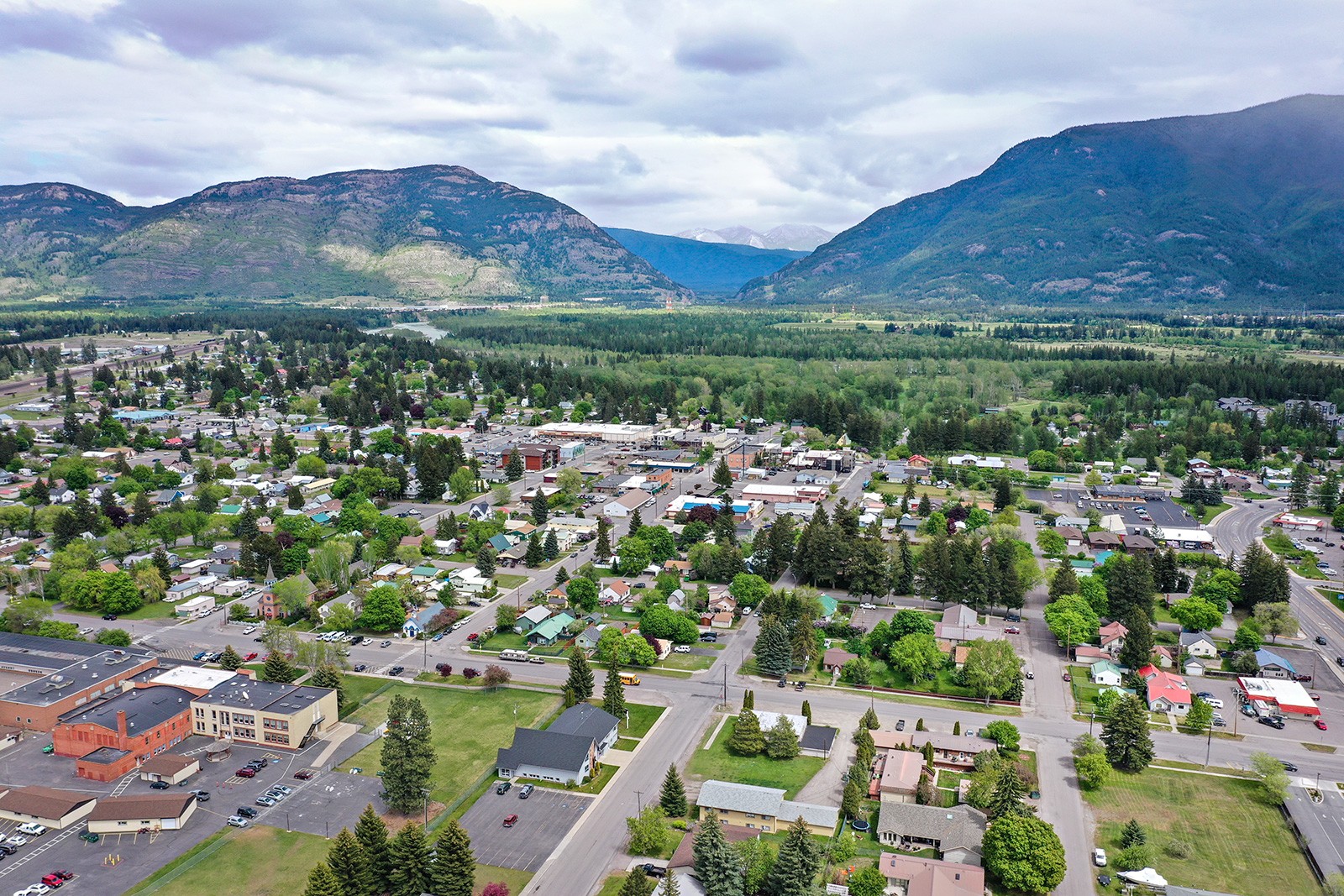
Columbia Falls Begins Piecing Together New Land Use Plan
Consulting firm Cushing Terrell presented the results of a community survey about the city’s future, as well as an “Existing Conditions” report to be used as a baseline ahead of 20 years of projected growth.
Ceres Bakery Celebrates 20 Years of Community in Downtown Kalispell
After weathering the Great Recession and the pandemic, owners Hannah Bjornson and Rick Grimm have maintained a community-centered atmosphere at the bakery on South Main Street where the sourdough bread and pastries are a staple of downtown
Whether you’ve been here for decades, or you’re new to the Flathead Valley, our reporting is here to help you feel smarter and in the loop about the issues most important to Northwest Montana. With your support, we can build a more engaged, informed community.