Greetings, Beacon Nation! And welcome to the top of the workweek. A moody mid-May weekend replenished the high-elevation snowpack and recharged the low-elevation mud puddles, but the forecast suggests these conditions are temporary.
I’m Tristan Scott, here to make a pitch for why readers ought not merely support the Whitefish Review, the nationally acclaimed nonprofit literary journal that eats, sleeps and grows in our backyard, but should also savor its existence. (Full disclosure: It’s the same pitch I peddle ad infinitum for why folks ought to back the Beacon, and it’s a campaign I don’t imagine retiring anytime soon.)
For starters, the Whitefish Review and the Beacon were founded around the same time, in 2007, when market conditions weren’t exactly clamoring for new print publications. Indeed, quite the opposite was true. Both the news and literary publishing industries faced historic disruption, driven by a declining print readership and the dawn of the digital era.
According to the Newspaper Association of America, 2007 signaled the worst downturn in the print advertising business in more than a half-century, setting the stage for seismic institutional changes and financial challenges. From 2005 to 2008, the market value of publicly traded newspapers nationwide plummeted 42%. Between 1990 and 2008, a quarter of all newspaper jobs were eliminated. Meanwhile, the e-book revolution officially got underway when Amazon released the original Kindle, shifting the publishing industry’s trajectory from a traditional print-only model to digital distribution.
And yet, in the hinterlands of Montana, the Flathead Valley was graciously receiving two newborn publications into the world: a weekly print tabloid newspaper and a semiannual perfect-bound literary journal. The seeds for both endeavors were planted and nurtured by reputed media and literary figures who saw immense value in promoting the free exchange of information, ideas and art in a place that’s widely regarded as the last of the best. I would also argue that its readers are the last of the lucky ones.
Since the Whitefish Review’s bold debut in 2007, when co-founder Brian Schott published a long-form interview with former NFL quarterback and sometimes Whitefish resident Drew Bledsoe about the “art of football” and bookended it with original pieces by literary powerhouses Tim Cahill and William Kittredge, the journal has been publishing a steady stream of distinctive literature, art and photography with an enlightened, if geographically unlikely, verve. It has featured more than 1,200 contributors and hosted over 60 public readings, providing a platform for budding artists and established figures alike.
For its part, the Flathead Beacon materialized when television personality and part-time Bigfork resident Maury Povich decided to start a weekly newspaper in Kalispell, which only seems slightly less crazy when you understand Povich’s deep personal connection to journalism, as well as his wife Connie Chung’s pioneering career in broadcast news. (Povich and Chung are pictured in the photo above at a speaking event about Connie’s life and career at Flathead Valley Community College last June.)
Even so, the little-literary-journal-that-could and the local-newspaper-that-never-might’ve-been have both grown into beanstalks, in large part because they were watered by the blood, sweat and tears of a committed coterie of individuals who believe that societies function better when information and ideas flow freely. And, more importantly, they’ve both received the resolute support of an audience whose members agree, even when they tend to disagree.
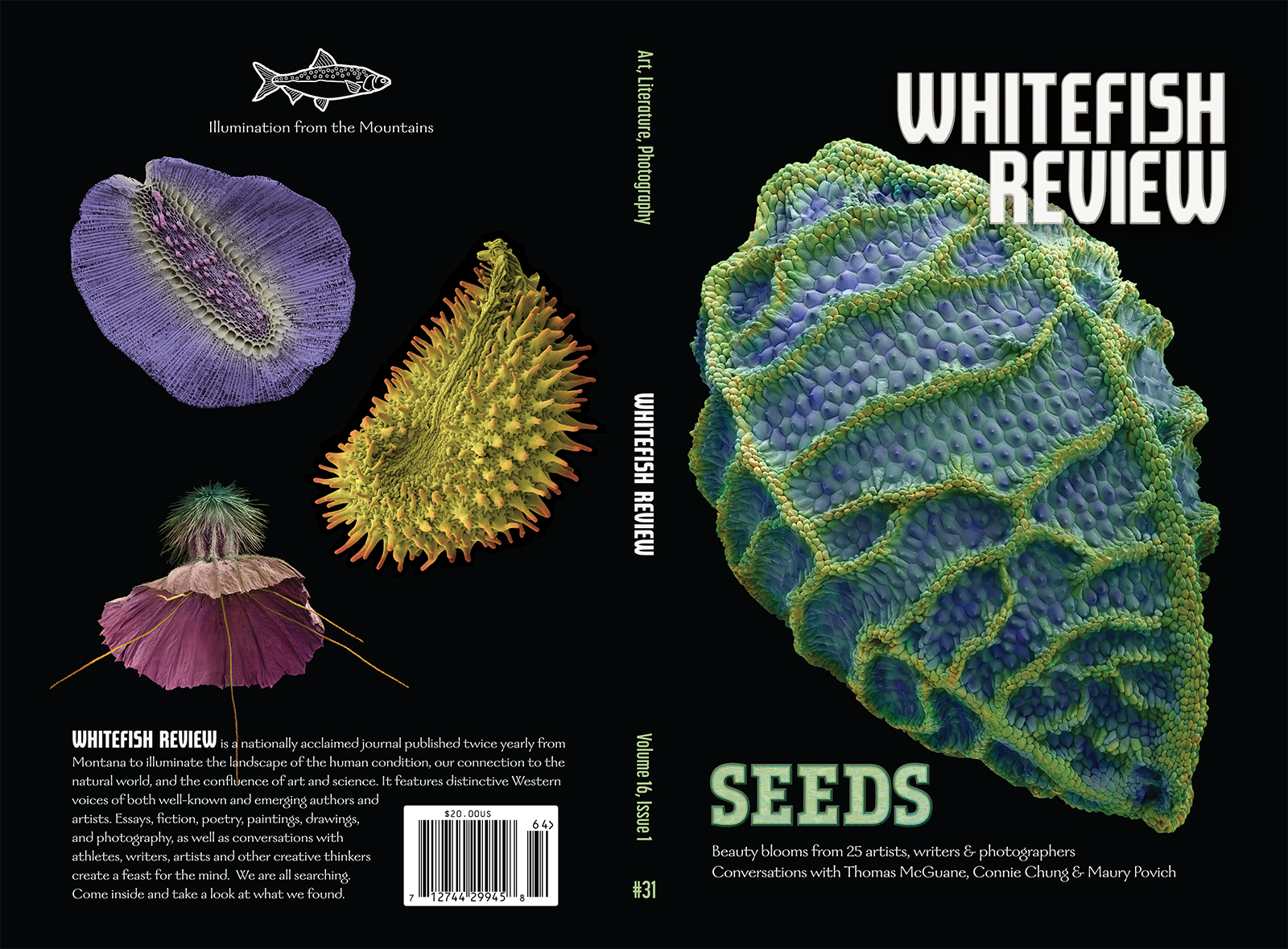
So, please allow me a bit of poetic license (or, rather, a bit of narcissus poeticus) in sharing the news that the Whitefish Review’s 31st issue features a conversation between its editors, Povich, and Chung, as well as some bonus commentary from the Beacon’s peanut gallery — namely, me and editor-in-chief Kellyn Brown.
The issue also features work from 25 writers and artists, including Montana Prize for Fiction winner Henry Hietala, selected by Rick Bass. Fiction, poetry, essays, photography, and visual art span voices from a local high school student to a poet in India.
Issue #31 also includes an interview with legendary Montana author and fisherman Tom McGuane, who reflects on creativity and his enduring love of fly fishing at age 86.
Whitefish Review will celebrate the release of its 31st issue, “Seeds,” on Friday, May 22, at 101 Central in downtown Whitefish. The evening will feature live music by singer-songwriter Siri Saeteren, readings by authors Rick Bass and Colleen O’Brien, and an essay by local high school student Kate Cooke. Doors open at 6:30 p.m., with live music beginning at 7 p.m. and readings at 8 p.m.
The evening is sponsored by 101 Central, Whitefish Credit Union, and Larch House. A suggested $10 donation will support the nonprofit journal. More information is available at WhitefishReview.org. Copies of the journal are available at local bookstores and online.
In a state that has historically heralded its independent streak, Bodnar's candidacy for the U.S. Senate sets up an experiment about whether a candidate running outside the two-party system can stave off Montana's one-party rule
2026 Primary Election: A Northwest Montana Voter’s Guide to Local and Statewide Races
Absentee ballots went out May 8. The primary takes place June 2. Voters in Flathead, Lake, Lincoln and Glacier counties will decide more than a dozen competitive races. Here's what to know.
Whitefish to Host Open House for Potential Railway Crossing Improvements
Residents can go to City Hall from 5 to 7 p.m. on May 20 to provide feedback on a range of projects, including a potential overpass at East Second Street, aimed at addressing safety and access limitations at railway crossings in the city.
Whether you’ve been here for decades, or you’re new to the Flathead Valley, our reporting is here to help you feel smarter and in the loop about the issues most important to Northwest Montana. With your support, we can build a more engaged, informed community.